
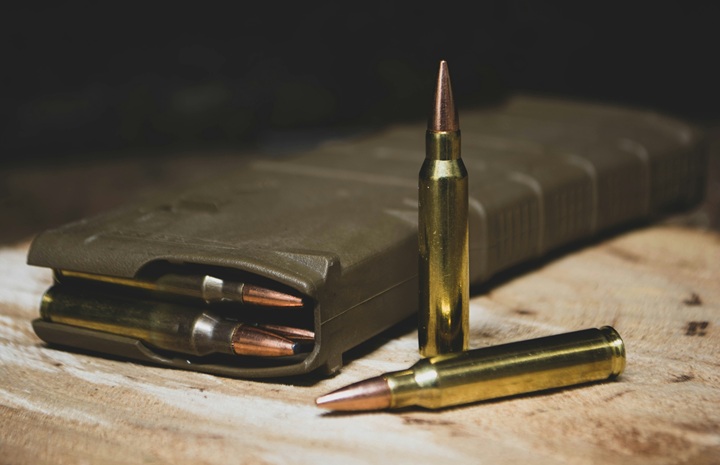
For nearly a century, the .270 Winchester and the .308 Winchester have stood among the most respected hunting cartridges ever developed. Both have earned loyal followings by delivering dependable accuracy, proven terminal performance, and the versatility needed to harvest everything from whitetail deer to elk. Their long-standing popularity has also ensured an abundance of rifles, ammunition, and aftermarket support, making either cartridge an excellent choice for hunters of all experience levels.
Choosing between them is not simply a matter of deciding which cartridge is more powerful. The better option depends on several factors, including the size of the game you hunt, the terrain you hunt in, your typical shooting distance, and whether you prefer a lightweight hunting rifle or one that can serve multiple purposes. Understanding the strengths and limitations of each cartridge will help you make a more informed decision.
In this comprehensive comparison, we’ll examine their history, specifications, ballistic performance, recoil, accuracy, hunting effectiveness, and overall versatility to determine where each cartridge excels and which one is best suited for your hunting style.
History of the .270 Winchester
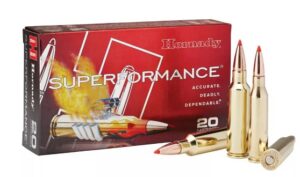
Introduced by Winchester in 1925, the .270 Winchester was created by necking down the .30-06 Springfield case to accept a .277-inch bullet. The goal was to produce a cartridge capable of achieving significantly higher velocities while maintaining enough power for North America’s most popular big-game species. The result was a cartridge that quickly earned a reputation for delivering flat trajectories, impressive accuracy, and dependable performance in the field.
Although the .270 initially enjoyed moderate success, its popularity soared thanks largely to legendary outdoor writer and hunter Jack O’Connor. Through decades of articles and hunting stories, O’Connor demonstrated the cartridge’s effectiveness on mule deer, sheep, elk, and numerous other western game animals. His confidence in the .270 Winchester inspired generations of hunters and helped establish it as one of the most influential sporting cartridges ever produced.
History of the .308 Winchester
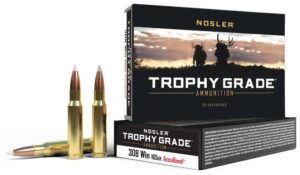
The .308 Winchester entered the market in 1952 with a very different design philosophy. Rather than pursuing maximum velocity, Winchester engineers sought to duplicate the performance of the .30-06 Springfield while using a shorter cartridge case that would function in more compact short-action rifles. The result was a cartridge that delivered outstanding efficiency without sacrificing practical hunting performance.
Its reputation grew even stronger when it became the civilian counterpart to the military’s 7.62×51mm NATO cartridge. Military adoption demonstrated the cartridge’s reliability and accuracy under demanding conditions, while civilian shooters quickly discovered its versatility for hunting, target shooting, and competitive marksmanship.
Cartridge Specifications
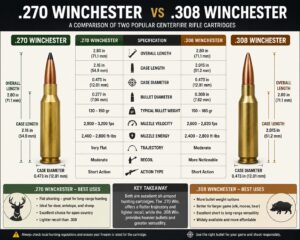
Although both cartridges have earned excellent reputations as hunting rounds, they differ considerably in their physical dimensions and design characteristics.
| Specification | .270 Winchester | .308 Winchester |
| Parent Case | .30-06 Springfield | 7.62×51 NATO |
| Bullet Diameter | .277 inch | .308 inch |
| Typical Bullet Weight | 90–150 grains | 110–180 grains |
| Common Hunting Loads | 130–150 grains | 150–180 grains |
| Case Length | 2.54 inches | 2.02 inches |
| Overall Length | 3.34 inches | 2.81 inches |
| Action Length | Long action | Short action |
That shorter case is the whole reason the .308 exists. It cycles faster in a bolt gun, works cleanly in short-action semi-autos like the AR-10 platform, and lets manufacturers build lighter mountain rifles or more compact tactical builds. 270 Winchester typically shoots lighter bullets faster, resulting in a flatter trajectory at longer ranges.
Bullet diameter also differs significantly. The .270 fires a narrower .277-inch projectile, while the .308 launches a larger .308-inch bullet. Combined with the .308’s broader selection of heavier projectiles, this contributes to its reputation for deeper penetration on larger animals.
Bullet Weight
Bullet weight plays a major role in determining how a cartridge performs, influencing everything from recoil and trajectory to penetration and retained energy. While both cartridges are excellent hunting choices, they achieve their performance through different approaches.
The .270 Winchester is most commonly loaded with bullets weighing between 130 and 150 grains. These relatively light projectiles allow the cartridge to achieve impressive muzzle velocities while maintaining a flat trajectory. Although lighter varmint bullets are also available, hunters generally rely on 130-, 140-, and 150-grain loads for medium and large game.
The .308 Winchester offers considerably more flexibility. Factory ammunition is commonly available in bullet weights ranging from 110 to 180 grains, with specialty loads extending beyond 200 grains. This wide selection allows shooters to tailor their ammunition for everything from predator hunting and target shooting to elk, moose, and black bear.
The heavier bullets available for the .308 generally retain momentum more effectively and penetrate deeper after impact, making them particularly valuable when hunting large-bodied animals. The .270, however, offsets its lighter bullets with significantly higher velocity, enabling it to shoot flatter and making long-range shot placement easier.
Ultimately, hunters who prioritize versatility and bullet selection will appreciate the .308, while those focused on speed and trajectory will find the .270 especially appealing.
Velocity Comparison
Velocity is one of the defining characteristics of the .270 Winchester and one of the primary reasons it has remained popular with hunters who frequently shoot across open country. Its lighter bullets and larger powder capacity allow it to achieve substantially higher muzzle velocities than the .308 Winchester.
Typical factory loads illustrate the difference:
| Cartridge | Bullet Weight | Approximate Muzzle Velocity |
| .270 Winchester | 130 gr | 3,050–3,100 fps |
| .270 Winchester | 150 gr | 2,850 fps |
| .308 Winchester | 150 gr | 2,800–2,850 fps |
| .308 Winchester | 165 gr | 2,650–2,700 fps |
| .308 Winchester | 180 gr | 2,550–2,620 fps |
Across comparable hunting loads, the .270 consistently launches its bullets several hundred feet per second faster than the .308. While that increase may not seem dramatic on paper, it has meaningful advantages in real hunting situations. Faster bullets reach the target more quickly, spend less time exposed to wind, and experience less gravitational drop during flight.
These characteristics produce a flatter shooting cartridge that requires less holdover at longer distances, allowing hunters to make accurate shots with greater confidence. For those who regularly hunt pronghorn, mule deer, sheep, or other game across expansive terrain, the .270’s higher velocity is one of its greatest strengths.
The .308 Winchester sacrifices some speed in exchange for heavier bullets and broader versatility. Although it cannot match the .270’s velocity, it remains more than capable of ethical shots at typical hunting distances and performs exceptionally well when greater bullet weight and penetration are required.
Trajectory Comparison
Trajectory is where the .270 Winchester truly begins to distinguish itself from the .308 Winchester. Because its bullets leave the muzzle at higher velocities, they maintain a flatter flight path, reducing bullet drop and simplifying longer shots.
With both rifles zeroed at 200 yards, a typical 130-grain .270 hunting load generally drops around 6 to 7 inches at 300 yards. A comparable 150-grain .308 load typically drops between 8 and 10 inches over the same distance. While this difference is relatively modest inside 300 yards, it becomes increasingly noticeable as distances continue to increase.
The flatter trajectory gives hunters a valuable margin of error when estimating range in the field. Less bullet drop means fewer elevation adjustments and less holdover, making accurate shot placement easier on distant game. These advantages have made the .270 Winchester particularly popular among hunters pursuing mule deer, pronghorn, sheep, and other species commonly found in open country where shots beyond 300 yards are more likely.
The .308 Winchester remains highly capable at extended ranges, especially in the hands of experienced shooters who understand their rifle’s ballistic performance. However, its slower velocity requires greater elevation adjustments and generally results in more bullet drop at longer distances. For hunters whose primary focus is maximizing long-range performance with minimal holdover, the .270 Winchester retains a clear ballistic advantage.
Energy Comparison
While the .270 Winchester is best known for its impressive velocity, the .308 Winchester often holds a slight advantage when it comes to delivering energy with heavier bullets. Both cartridges generate similar muzzle energy with common hunting loads, but the way they retain and transfer that energy differs because of their bullet weights and sectional density.
Typical factory loads illustrate how closely matched these cartridges are at the muzzle:
| Cartridge | Bullet Weight | Approximate Muzzle Energy |
| .270 Winchester | 130 gr | 2,700 ft-lbs |
| .270 Winchester | 150 gr | 2,700 ft-lbs |
| .308 Winchester | 150 gr | 2,650 ft-lbs |
| .308 Winchester | 165 gr | 2,670 ft-lbs |
| .308 Winchester | 180 gr | 2,700+ ft-lbs |
Although the numbers appear nearly identical, heavier .308 bullets generally retain momentum more effectively as they travel downrange. This additional momentum often translates into deeper penetration through muscle and bone, making the cartridge particularly effective on larger animals such as elk, moose, and black bear.
The .270 Winchester achieves excellent terminal performance through speed rather than sheer bullet mass. Its higher velocity promotes reliable bullet expansion and devastating performance on deer-sized game while still providing enough energy for elk when paired with premium controlled-expansion bullets. For most hunting situations, both cartridges offer more than enough energy for ethical harvests, but hunters pursuing larger game may appreciate the additional penetration provided by the .308’s heavier projectiles.
Recoil Comparison
Neither the .270 Winchester nor the .308 Winchester is considered a heavy-recoiling cartridge, and most hunters can shoot either comfortably. However, subtle differences in recoil characteristics can influence shooting comfort, particularly during extended practice sessions or when introducing new shooters to centerfire rifles.
The .270 Winchester generally produces slightly less felt recoil because it fires lighter bullets at higher velocities. Most shooters describe its recoil as quick and relatively mild, allowing them to recover quickly between shots while reducing shoulder fatigue over the course of a long day at the range. This manageable recoil makes the .270 an attractive option for hunters who prioritize comfort without sacrificing hunting performance.
The .308 Winchester produces a somewhat stronger push, particularly when loaded with 165- or 180-grain hunting bullets. While the increase in recoil is noticeable, it remains well within the comfort range of most experienced shooters. Many hunters willingly accept the extra recoil because it accompanies heavier bullets capable of penetrating large-bodied game more effectively.
The actual difference in recoil also depends on rifle weight, stock design, recoil pad quality, and ammunition selection. A lightweight mountain rifle chambered in either cartridge will produce noticeably more felt recoil than a heavier rifle intended for range shooting. Even so, neither cartridge is likely to discourage regular practice, which remains one of the most important factors in becoming an accurate and confident hunter.
Accuracy Comparison
Accuracy has helped establish both cartridges as longtime favorites among hunters and precision shooters. While debates often arise over which cartridge is inherently more accurate, the truth is that both are capable of exceptional precision when paired with a quality rifle and suitable ammunition.
The .308 Winchester has long been associated with military sniper rifles, law enforcement marksmen, and precision rifle competitions. Its efficient case design, moderate operating pressures, and extensive selection of match-grade ammunition have contributed to a reputation for remarkable consistency at medium and long ranges. Even today, many precision shooters continue to rely on the .308 because of its predictable performance and widespread availability.
The .270 Winchester may not have the same competitive shooting history, but it is no less capable in the hunting field. Many factory rifles routinely produce sub-MOA groups with quality hunting ammunition, providing more than enough precision for ethical shots on big game. Its flatter trajectory can even make practical field shooting easier by reducing the need for elevation corrections at longer distances.
For the average hunter, differences in accuracy between the two cartridges are negligible. Factors such as rifle quality, optics, ammunition selection, environmental conditions, and shooting technique have a far greater influence on real-world accuracy than the choice between these two proven cartridges.
Hunting Performance
The true measure of any hunting cartridge is how it performs in the field, and both the .270 Winchester and the .308 Winchester have built legendary reputations through decades of successful hunts. Each is capable of ethically harvesting a wide variety of North American game, although their individual strengths become more apparent depending on the size of the animal and the hunting environment.
1) Deer
Whitetail, mule deer, and blacktail deer fall well within the capabilities of both cartridges. The .270 Winchester’s flatter trajectory makes longer shots easier across open terrain, while the .308 Winchester delivers heavier bullets that often produce slightly larger wound channels. In practical hunting situations, either cartridge provides more than enough power for clean, ethical harvests when loaded with quality hunting ammunition.
Winner: Tie
2) Elk
Both cartridges have accounted for countless elk over the decades, but the .308 Winchester enjoys a slight advantage because of its heavier 165- and 180-grain bullets. These projectiles penetrate deeply through heavy muscle and bone, increasing confidence when hunting one of North America’s largest big-game animals.
The .270 Winchester remains an excellent elk cartridge when loaded with premium controlled-expansion bullets weighing 140 or 150 grains. Success depends more heavily on careful shot placement, but experienced hunters have repeatedly demonstrated that the cartridge is fully capable of taking elk under appropriate conditions.
Winner: Slight Edge to .308 Winchester
3) Moose
Moose are among the largest animals hunted in North America, making deep penetration especially important. The .308 Winchester’s heavier bullet options provide an advantage by maintaining momentum as they pass through thick muscle and heavy bone.
Although the .270 Winchester has certainly harvested many moose throughout its history, most hunters prefer the additional bullet weight and penetration offered by the .308 when pursuing animals of this size.
Winner: .308 Winchester
4) Black Bear
Black bears possess dense muscle, heavy shoulders, and substantial bone structure that often reward the use of heavier hunting bullets. The .308 Winchester’s larger selection of 165- and 180-grain projectiles generally delivers superior penetration and reliable terminal performance.
The .270 remains capable of harvesting black bears with proper bullet selection, but hunters who regularly pursue bears often favor the .308 because of its greater margin for error on difficult shot angles.
Winner: .308 Winchester
5) Pronghorn and Sheep
Few cartridges have earned a stronger reputation for hunting open-country game than the .270 Winchester. Its high velocity and exceptionally flat trajectory simplify longer shots across prairies, sagebrush flats, and mountainous terrain where opportunities frequently occur beyond 300 yards.
These characteristics explain why generations of western hunters have trusted the .270 for pronghorn, bighorn sheep, mountain goats, and mule deer. While the .308 remains entirely capable of harvesting these animals, it cannot quite match the .270’s long-range ballistic performance.
Winner: .270 Winchester
6) Coyotes
Both cartridges are effective predator rounds, although they are larger than many hunters consider necessary for coyotes. The .270 Winchester’s higher velocity offers a slight advantage for longer shots by reducing bullet drop and shortening flight time.
Hunters interested in preserving pelts often choose smaller calibers such as the .223 Remington, but if either cartridge is already being carried for deer hunting, both will perform exceptionally well on predators.
Winner: Slight Edge to .270 Winchester
Long-Range Performance
As shooting distances increase, the .270 Winchester gradually begins to separate itself from the .308 Winchester. Its higher muzzle velocity produces a flatter trajectory, less bullet drop, reduced wind drift, and shorter flight times, all of which simplify accurate shot placement beyond 300 yards.
These characteristics make the .270 particularly appealing to hunters who spend much of their time in western states or other regions where open landscapes frequently require longer shots. Less bullet drop means fewer elevation adjustments and greater forgiveness when estimating range under field conditions.
The .308 Winchester remains an excellent long-range cartridge and has demonstrated its capabilities in countless precision shooting competitions and military applications. However, because its bullets travel at lower velocities, shooters generally need to compensate for greater bullet drop and wind drift as distances increase.
For hunters who regularly pursue game in open country, the .270 Winchester offers a meaningful ballistic advantage. Those whose hunting is primarily conducted in wooded terrain or at moderate distances are unlikely to notice a significant practical difference, as both cartridges perform exceptionally well within normal hunting ranges.
Ammunition Availability
The .308’s military pedigree means it’s manufactured in enormous volume worldwide, by more companies, in more bullet weights and configurations, than almost any other centerfire rifle cartridge. That translates to lower average prices and better shelf availability, particularly during ammunition shortages when military-adjacent calibers tend to recover fastest.
The .270 is a mainstream cartridge and never hard to find at a well-stocked sporting goods store, but it typically sits a little higher on price per box and offers noticeably fewer loaded options than the .308.
Rifle Availability
Just as ammunition is easy to find, rifles chambered in both cartridges are available from virtually every major firearms manufacturer. Whether you prefer a traditional bolt-action hunting rifle, a lightweight mountain rifle, or a precision target rifle, you’ll have no shortage of options.
The .270 Winchester has long been associated with classic bolt-action hunting rifles. Popular models from manufacturers such as Winchester, Remington, Savage, Ruger, Browning, and Tikka are routinely offered in .270, making it one of the easiest hunting calibers to find.
The .308 Winchester offers even greater flexibility. Because it uses a short-action case, manufacturers can build rifles that are lighter, more compact, and often cycle faster than comparable long-action rifles. In addition to traditional hunting rifles, the .308 is commonly chambered in precision rifles, scout rifles, and numerous semi-automatic platforms, including AR-10-style rifles.
For hunters who value compact rifle designs or want a firearm capable of both hunting and target shooting, the .308 Winchester provides a broader selection of rifle platforms. The .270 Winchester, however, remains an outstanding choice for hunters seeking a traditional bolt-action rifle designed specifically for big-game hunting.
Barrel Life
Barrel throat erosion tracks closely with case capacity, pressure, and velocity, and the .270 pushes more powder through a smaller bore than the .308 does. Practically, that means a .270 barrel showing accuracy loss somewhere in the 2,500 to 3,000 round range is normal, while a .308 barrel often holds acceptable accuracy out to 4,000 rounds or more under similar conditions. For a hunter putting 40-60 rounds through a rifle a year, this is close to irrelevant. For a dedicated shooter running a rifle hard through load development and range sessions, it’s worth factoring in.
Advantages of the .270 Winchester
The .270 Winchester has earned its reputation by delivering exceptional long-range hunting performance. Its combination of high velocity, manageable recoil, and flat trajectory makes it especially effective for hunters who regularly pursue game across open landscapes.
Some of its greatest strengths include:
- Exceptionally flat trajectory
- Higher muzzle velocity
- Less bullet drop at extended ranges
- Slightly lighter felt recoil
- Excellent performance in open-country hunting
- Outstanding choice for deer, antelope, sheep, and mountain game
- Easier holdover at longer distances
- Proven hunting record spanning nearly a century
For hunters who value speed and simplicity at longer distances, few traditional hunting cartridges rival the .270 Winchester.
Advantages of the .308 Winchester
The .308 Winchester has become one of the most versatile rifle cartridges ever produced. Its broad selection of bullet weights and compatibility with numerous rifle platforms allow it to excel in hunting, precision shooting, and recreational target shooting alike.
Its primary advantages include:
- Wider variety of factory ammunition
- Greater selection of bullet weights
- Better penetration with heavy hunting bullets
- Outstanding accuracy potential
- Compatible with lightweight short-action rifles
- Available in both bolt-action and semi-automatic platforms
- Longer barrel life
- Excellent performance on larger game animals
For hunters seeking one cartridge that can comfortably handle nearly every shooting discipline, the .308 Winchester is difficult to surpass.
Which One Should You Choose?
Choosing between the .270 Winchester and the .308 Winchester ultimately comes down to your hunting style and the type of game you pursue most often. Neither cartridge is universally better, but each excels under different circumstances.
The .270 Winchester is an excellent choice if you:
- Primarily hunt deer, pronghorn, sheep, or similar-sized game.
- Frequently shoot beyond 300 yards.
- Hunt in open country where a flat trajectory is an advantage.
- Prefer slightly lighter recoil.
- Value maximum velocity and simplified long-range shooting.
The .308 Winchester may be the better option if you:
- Hunt a wide variety of game, including elk, black bear, and moose.
- Want access to an extensive selection of bullet weights and factory ammunition.
- Prefer a compact short-action rifle.
- Plan to use the same rifle for hunting, target shooting, and recreational practice.
- Value versatility over maximum velocity.
Because both cartridges have proven themselves over generations of successful hunts, the decision should be based on how you hunt rather than on small differences in ballistic performance. Selecting quality ammunition and becoming thoroughly familiar with your rifle will have a far greater impact on success than choosing one cartridge over the other.
Final Verdict
The .270 Winchester and the .308 Winchester have remained among the world’s most popular hunting cartridges because each offers an outstanding balance of accuracy, reliability, and field performance. Their continued success over decades of hunting is a testament to thoughtful design rather than marketing hype, and either cartridge is capable of delivering clean, ethical harvests when paired with quality ammunition and good shot placement.
The .270 Winchester distinguishes itself through higher velocity, flatter trajectories, and reduced bullet drop, making it particularly well suited for hunters who spend much of their time in open country where longer shots are common. Its mild recoil and impressive ballistic performance have made it a favorite among generations of deer, antelope, sheep, and mountain hunters.
The .308 Winchester, meanwhile, shines because of its remarkable versatility. Its broad selection of bullet weights, excellent penetration with heavier projectiles, compatibility with compact short-action rifles, and widespread availability make it one of the most adaptable rifle cartridges ever developed. Whether hunting whitetails, pursuing elk in rugged country, or spending weekends at the shooting range, the .308 consistently delivers dependable performance.
In the end, there is no universal winner. If your priority is long-range hunting with the flattest possible trajectory, the .270 Winchester is difficult to beat. If you want a single cartridge capable of handling a wider variety of game and shooting applications, the .308 Winchester is the more versatile choice. Regardless of which one you select, mastering your rifle, practicing regularly, and placing your shots with confidence will always matter far more than the modest differences between these two legendary hunting cartridges.
Related