
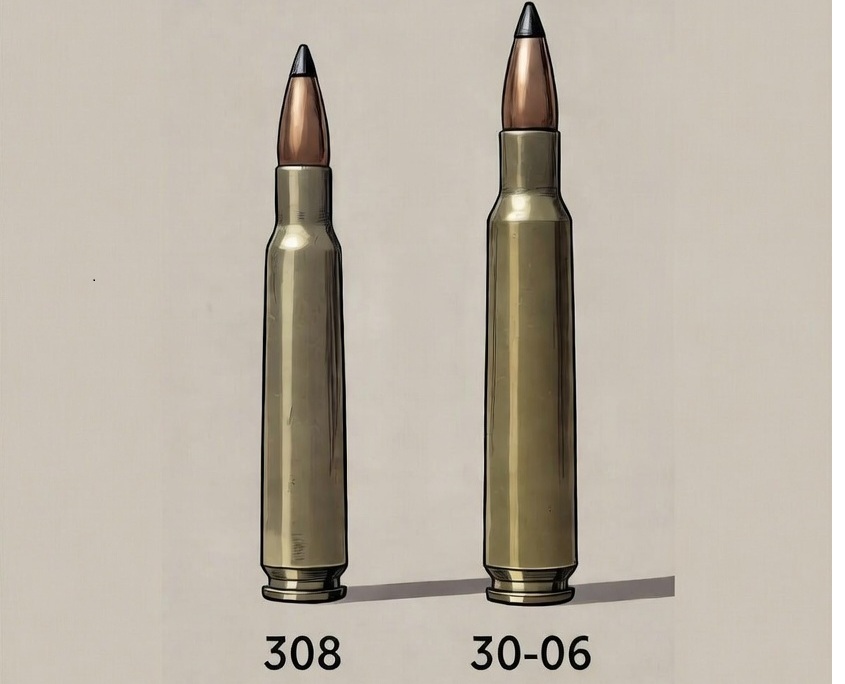
For over half a century, a friendly but fierce debate has lived in hunting camps and gun ranges across the world. The debate on which one you should own, should it be the .308 Winchester or the .30-06 Springfield? Both rounds use the exact same .30-caliber bullets, meaning they are capable of taking down the same game, but the way they deliver those bullets is remarkably different. Understanding the nuances between these two legends is the key to choosing the right rifle for your specific needs.
History
.30-06 Springfield
The elder statesman of the two, adopted by the U.S. military in 1906. It served through both World Wars and Korea, earning a reputation for being a powerhouse that could reach out and touch targets with authority. Its long action design was built around the slower-burning powders of the early 20th century, requiring a physically longer casing to hold enough propellant to get the job done.
.308 Winchester
Also known in the military as 7.62x51mm NATO arrived much later, in the early 1950s. By this time, gunpowder technology had advanced significantly. Engineers realized they could achieve nearly the same performance as the .30-06 using a much smaller, more efficient case. This resulted in the short-action cartridge we know today, which quickly became the standard for military snipers and precision competition shooters due to its inherent efficiency and consistency.
308 vs 30-06 Key Differences
Power and Ballistics.
When it comes to raw horsepower, the .30-06 Springfield holds the crown. Because the case is physically larger, it can hold more gunpowder, which generally translates to higher muzzle velocities. With standard 150-grain or 165-grain bullets, the .30-06 typically travels about 100 to 150 feet per second faster than the .308. While that might not sound like a massive difference, it results in a slightly flatter trajectory and more kinetic energy delivered to the target at long distances.
The real advantage of the .30-06, however, appears when you use heavy bullets. If you plan on hunting large game like moose or grizzly bears, the .30-06 can comfortably stabilize 200-grain or 220-grain projectiles that the .308 struggles to push effectively. The .308 Winchester is at its best with 150-grain to 175-grain bullets; within those weights, it is incredibly accurate and performs almost identically to the .30-06 out to about 400 yards.
Recoil and Shooter Comfort
One of the most significant practical differences between these two is the felt recoil. Because the .30-06 uses more powder to push bullets faster, it generates more kick. On average, a .30-06 produces about 20% more recoil than a .308 Winchester in a rifle of the same weight. For many hunters, this isn’t a dealbreaker, but for high-volume shooters or those who are sensitive to shoulder pain, the .308 is much more pleasant to fire.
The lower recoil of the .308 isn’t just about comfort; it’s about accuracy. It is much easier to maintain good shooting form when the rifle isn’t punishing your shoulder. This is why the .308 is often recommended for new shooters or those who spend hours at the range practicing precision shots. If you can shoot more comfortably, you will generally shoot more accurately.
Rifle Weight and Action Length
Because the .308 Winchester is a shorter cartridge, it fits into short-action rifles. These rifles have a shorter bolt throw, meaning you don’t have to pull the bolt back as far to chamber the next round. More importantly, short-action rifles are typically half a pound to a full pound lighter than their long-action counterparts. For a mountain hunter who is hiking ten miles a day through steep terrain, that weight savings is a massive benefit.
The .30-06 requires a long-action receiver to accommodate its length. While this makes the rifle slightly heavier and the bolt pull slightly longer, it provides a level of versatility that the .308 cannot match. A long-action rifle gives you the flexibility to handload longer, more aerodynamic bullets that simply won’t fit into a short-action magazine.
For the traditionalist who wants one rifle that can do everything from deer in the woods to elk across a canyon, the extra weight of the long-action is a fair trade-off.
Availability and Versatility
In terms of finding ammunition, you really can’t lose with either choice. Both the .308 and the .30-06 are among the top three most popular centerfire cartridges in the world. Whether you are in a massive sporting goods store in the city or a tiny hardware shop in a rural mountain town, you will almost certainly find boxes of both on the shelf.
The .308 Winchester has a slight edge in match-grade options because of its popularity in the tactical and competitive worlds. Conversely, the .30-06 has a wider variety of specialized hunting loads, ranging from light rounds for kids to heavy-hitting loads for the largest game. Ultimately, the .308 is the king of efficiency and precision, while the .30-06 remains the king of versatility and raw power.
Frequently Asked Questions (FAQs)
Can I shoot .308 in a 30-30 rifle?
No, you absolutely cannot. While both use .30-caliber bullets, they are entirely different cartridges. The .308 Winchester operates at much higher pressures (up to 62,000 psi) than the .30-30 (around 42,000 psi).
Attempting to fire a .308 in a .30-30 would likely cause the rifle to explode, leading to catastrophic injury.
Can the .308 Winchester effectively take down an elk?
Yes, the .308 Winchester is a highly effective elk cartridge when used within its ethical limits, and when paired with a heavy, high-quality hunting bullet such as a 165 or 180-grain Partition or Bonded bullet.
For a clean, humane kill on a large animal like an elk, it is generally recommended to keep shots under 300 to 400 yards to ensure the bullet maintains enough kinetic energy and velocity for proper expansion.
30-06 vs 308: Which one is more accurate?
In a strictly technical sense, the .308 Winchester is often considered more inherently accurate. This is due to its shorter, fatter case design, which allows the gunpowder to burn more consistently and efficiently than the longer .30-06 casing. This consistency leads to less vertical stringing in shot groups. However, for 99% of hunters and casual shooters, this difference is negligible.
Why do military and police snipers prefer .308 over .30-06?
Professional marksmen moved toward the .308 Winchester primarily because it offers a perfect balance of performance and efficiency. The .308 fits into a short-action rifles, which is lighter, more rigid, and allows for a faster bolt throw than the long-action .30-06.
Furthermore, the .308 produces significantly less recoil, allowing snipers to stay on target through the scope and see their bullet impact, which is vital for making rapid follow-up shots.
Related