
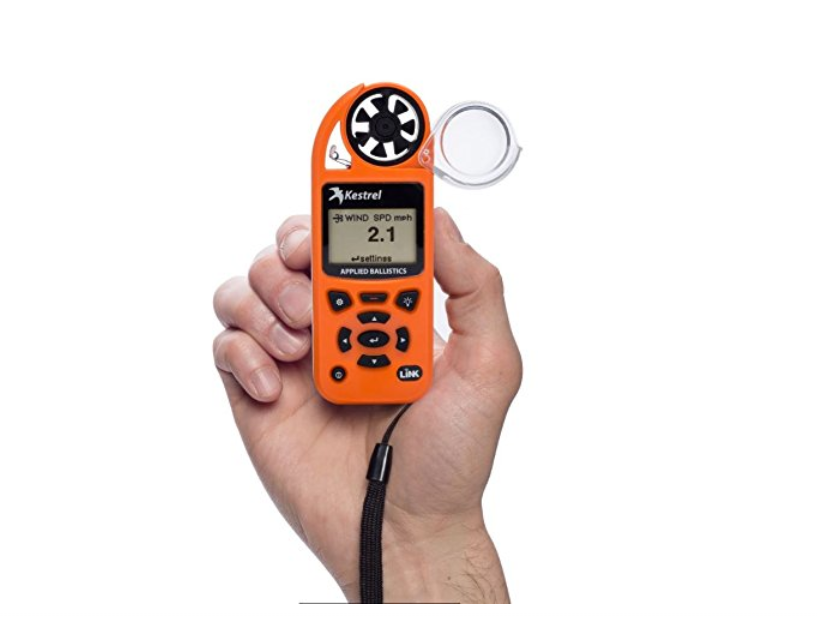
For a committed marksman, a ballistic weather meter is an important tool that converts the invisible atmospheric chaos into data that you can use to hit a target 500, 800, or 1500 yards out. The best meter will bring out the hidden talent of a long-range shooter and make accuracy seem easy.
This guide is here to walk you through the best ballistic weather meters on the market, and also explain to you what you need to consider before you choose one.
Quick recap
In-depth reviews
1) Kestrel Ballistics Elite Weather Meter
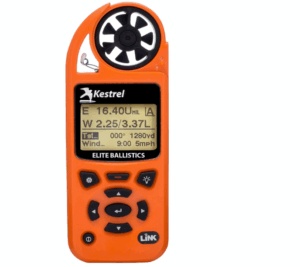
The Kestrel Elite is the gold standard for serious long-range shooters who demand precision in every shot. It’s more than a weather meter. It’s a complete ballistic computer that measures real-time wind, temperature, pressure, humidity, and density altitude, then instantly translates that data into an accurate firing solution.
Powered by the trusted Applied Ballistics Elite solver, it accounts for spin drift, Coriolis effect, and aerodynamic jump, giving you the same precision tools used by professionals and competitive marksmen. You can store up to 30 rifle profiles and 10 target settings, so switching between setups is effortless.
Built tough to military standards, it’s waterproof, shock-resistant, and ready for any environment. The bright, sunlight-readable display and long-lasting AA battery make it dependable in the field. Whether you’re a hunter, sniper, or precision shooter, the 5700 Elite delivers accuracy you can trust when conditions matter most.
Pros
- Advanced Applied Ballistics solver for extreme-range precision
- Stores 30 rifle profiles and 10 targets
- Durable IP67 waterproof and MIL-STD-rated construction
- Bluetooth connectivity for easy updates and data transfer
- Uses standard AA battery with long life
Cons
- Expensive compared to simpler models
- Requires time to learn and input accurate ballistic data
2) Kestrel 5700X WEZ Weather Meter with Applied Ballistics
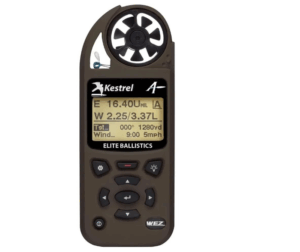
The Kestrel 5700X WEZ seamlessly combines high-accuracy environmental sensing with advanced ballistics analytics. It features the Applied Ballistics Elite solver with full WEZ (Weapon Employment Zone) capability, enabling shooters to compute probability-of-hit (P HIT) across multiple targets and firearm/load profiles.
It measures key parameters, temperature, pressure, humidity, density altitude, and more, and supports G1/G7/custom drag curves, aerodynamic jump, spin drift, and Coriolis correction. Built to MIL-STD-810G drop standards and sealed to IP67 for rugged field use, it also offers LiNK Bluetooth wireless connectivity for data transfer and profile loading.
With storage for up to 30 gun/bullet profiles and 10 targets, plus a sunlight-readable display with night-vision back-lighting, it’s engineered for serious precision shooters working long-range or multi-weapon setups.
Pros
- Elite Applied Ballistics solver with full WEZ analytics
- Rugged build
- Bluetooth LiNK connectivity for profile transfer, logging
- Storage for 30 gun/bullet profiles and 10 target profiles
- Sunlight-readable display plus night-vision back-light
Cons
- High cost compared to basic weather meters
- Complexity requires training to exploit full WEZ features
- Reliance on software and firmware increases potential setup burden
- May be over-spec’d for casual or short-range shooters
3) Kestrel 5700x Elite
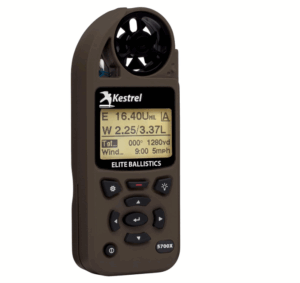
If you’re a shooter who wants both raw environmental data and sophisticated ballistic insight in one handheld tool, the 5700 Elite is built for you. It measures wind speed/direction, temperature, humidity, pressure, and altitude, and then uses the full Applied Ballistics engine, including custom drag curves, high-angle correction, spin drift, and Coriolis adjustments, to give you precise firing solutions.
You can store up to 30 rifle/load profiles and 10 target cards, so switching rifles or loads in the field is way simpler. Built tough, it’s waterproof, drop-tested, and powered by a standard AA battery.
The backlit display works in bright sun or low light, and Bluetooth LiNK connectivity lets you load profiles from your phone. For serious shooters who don’t want a separate weather meter and ballistic calculator, the 5700 Elite wraps everything into one solid package.
Pros
- Fully integrated weather + advanced ballistic solver
- Supports 30 gun/load profiles + 10 targets
- Rugged build
- Sunlight, and a night-readable display
- AA battery operation
Cons
- Pricey
- Requires setup time and learning
4) Kestrel 2700 Ballistics
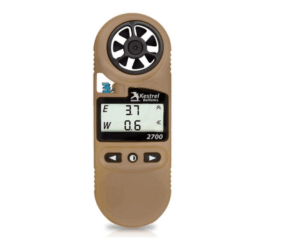
The Kestrel 2700 Ballistics Weather Meter is a streamlined, stand-alone field instrument that combines environmental sensing with a ballistic calculator, designed for long-range shooting up to approximately 875 yards.
It’s positioned as an affordable entry point for shooters who want integrated ballistics and weather measurement without high complexity or cost.
It measures wind speed, wind direction, temperature, and altitude/pressure on-site, and uses a G1/G7 drag model ballistics solver drawn from the Applied Ballistics library.
You build your rifle/load profile in the free LiNK app, upload it to the unit, then leave your phone behind for on-range use.
Ruggedly built to IP-67 waterproofing and MIL-STD-810 drop standards with a 5-year warranty, it offers “Load & Go” simplicity with a three-button interface and a dedicated single-target display for elevation and windage solutions.
Pros
- Integrated environmental sensors and ballistic solver in one handheld unit.
- Rugged construction
- Easy to set up via LiNK app
- Dedicated single-target display simplifies field use
- Budget-friendly.
Cons
- Limited to one gun/load profile at a time
- Lacks advanced ballistic corrections
5) WeatherFlow / WEATHERmeter
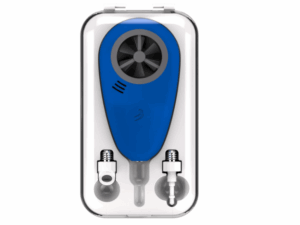
The WeatherFlow WEATHERmeter for Precision Shooting is a compact Bluetooth-enabled environmental meter designed for long-range shooters who demand
It measures wind speed and direction, barometric pressure, temperature, humidity, and calculates density altitude. It pairs with mobile ballistic apps to feed real-time data for trajectory adjustments.
The device provides wind speed readings from 0.5 to 125 mph with ±0.5% accuracy, temperature readings from −10 °F to 140 °F with ±0.7 °F accuracy, and a barometric pressure range of 8.9 to 32.5 inHg with ±0.0004 inHg accuracy.
Its lightweight form and Bluetooth Smart (BLE) connectivity make it an economical choice for shooters who already rely on a smartphone for ballistic calculation.
Pros
- Measures full environmental suite: wind speed/direction, temp, humidity, pressure, density altitude.
- Integrates seamlessly via Bluetooth with major ballistic apps.
- Excellent value compared to high-end dedicated weather meters.
- Lightweight, portable, and easy to deploy in the field.
- Good accuracy specifications for key parameters (wind speed, temperature, pressure).
Cons
- Requires a smartphone and a ballistic app for full functionality
- Lacks onboard ballistic solver and gun/load profile storage.
Ballistic Weather Meter Buying Guide
Accuracy and sensor quality
Accuracy is the single most important factor for a ballistic weather meter. High-quality devices use precision sensors for temperature, barometric pressure, humidity, and wind.
Pressure and temperature combine to determine density altitude, a primary driver of bullet drag, so sensors that return stable, fast, and accurate readings directly translate to better firing solutions. Cheap meters may show wind speed, but inaccuracies in pressure or temperature readings will mislead trajectory outputs, especially at long ranges.
Ballistics solver and software
A meter’s value multiplies when paired with a strong ballistic solver. On-device solvers let you get full firing solutions without a phone. Phone-dependent meters rely on app solvers, which can be equally powerful but introduce dependence on mobile hardware and software.
Decide whether you want solver power on the instrument or are comfortable relying on a mobile app ecosystem for modeling features like custom drag curves, Coriolis, and WEZ.
Bluetooth, app integration
Connectivity matters if you want to save logs, share data, or use a phone for heavy computations. Robust Bluetooth connections, good app interfaces, and available desktop tools improve workflow. Pay attention to whether a device supports LiNK or proprietary apps, what mobile platforms are supported, and whether the meter can stream data in real time to multiple devices helpful for spotters and teams.
Durability, size, and ergonomics
A ballistic meter will be handled in cold, wet, and dusty conditions. Ruggedness, water resistance, and a compact form factor are practical considerations. A meter that fits comfortably in a vest pocket, attaches to a tripod, or mounts on a small tripod with a 1/4-20 thread expands its use cases. Night-vision displays are important for users who operate in low light with NV gear.
Battery life and power options
Long days in the field demand long battery life. Consider models that use replaceable AA batteries versus internal rechargeable packs. Bluetooth streaming drains batteries faster. Also, evaluate whether the meter charges from common power banks or requires proprietary chargers.
Price and cost of ownership
Price ranges widely, from cheap pocket anemometers through midrange phone-paired meters to four-figure, AB-enabled Kestrel machines. Factor in the total ownership cost, which includes warranty, sensor calibration services, app subscription fees, and the cost of accessories. Also note that the most expensive unit isn’t automatically best unless you need its unique capabilities.
Warranty, support, and aftermarket
Kestrel and established brands offer warranties and repair programs that matter if the meter gets knocked around. Check return policies, firmware update histories, and community support. Firmware updates can add features or fix problems, prolonging a device’s useful life.
FAQs (Frequently Asked Questions)
What is a ballistic weather meter?
A ballistic weather meter is a handheld instrument that measures environmental conditions such as wind speed and direction, air temperature, humidity, barometric pressure, and often pairs that data with a ballistic solver to calculate holdover, windage, time-of-flight, and other trajectory factors. Essentially, it turns environmental uncertainty into actionable data so shooters can make first-shot hits.
Do I really need a ballistic weather meter to shoot accurately?
For short ranges (under 200 yards), you can often rely on basic holdovers and experience; however, as distance increases, environmental factors exponentially affect bullet flight. A ballistic weather meter supplies objective, repeatable data (pressure, temperature, humidity, wind speed) that transforms guesswork into predictable corrections. For precision shooting, especially beyond 400–500 yards, a meter is a high-value tool.
What’s the difference between a Kestrel 5700X and the 5700 Elite?
The 5700X and 5700 Elite share the Applied Ballistics foundation; the 5700X typically adds higher processing speed, faster firing-solution updates, and specialized WEZ features in certain configurations. The Elite remains a capable AB platform, while the 5700X is tuned for quicker calculations and multi-target scenarios. In practice, the 5700X is a premium upgrade for high-tempo ELR use.
Can my phone replace a dedicated meter?
Smartphones, paired with a quality ballistic app, can perform advanced modeling. Applied Ballistics and BallisticsARC are powerful examples. But phones rely on accurate environmental inputs. Without a dedicated, calibrated meter for pressure and wind, phone solutions depend on manual entry or third-party probes. For full reliability, combine a phone app with a proven meter or choose a device with an on-board solver.
How important is wind direction vs wind speed?
Wind direction is as important as speed. Crosswinds cause lateral deflection, while head/tail winds change time-of-flight and drag. Knowing both wind speed and the wind’s angle relative to the target is critical. Many meters and apps allow you to enter wind direction and the angle to target to compute the crosswind component automatically.
How do I calibrate or validate my meter?
Sensors typically arrive factory-calibrated. For long-range work, validate by comparing density altitude and pressure readings to a local airport station or to a known reference meter. Many users perform a field check against a trusted Kestrel or a weather station. Maintain firmware updates and follow the manufacturer’s recommendations for recalibration or repair if readings drift.
Will extreme cold or heat affect readings and battery life?
Yes. Sensor response time and battery performance degrade in extremes. Cheap meters may take longer to stabilize during rapid temperature changes. Units designed for field use manage thermal transients better and often recommend keeping spare batteries warm in cold weather. Expect reduced run time in the cold and allow meters a short stabilization period after moving between extreme temperatures.
Can a meter measure wind direction or only speed?
Some meters only measure wind speed/gust/average. More advanced units capture wind direction and can compute crosswind component if you input the target angle or azimuth. Wind direction is critical because a 10 mph tailwind affects bullets differently than a 10 mph crosswind. For accurate windage corrections, especially at longer range, direction matters.
What is WEZ, and why does it matter?
WEZ stands for Weapon Effects Zone. It’s a probabilistic model that estimates hit probability given a set of environmental variables, weapon characteristics, and ammunition performance. A meter that supports WEZ helps prioritize ranges and ammo choices by showing where your system produces the best likelihood of a hit, invaluable for tactical planning and ammo selection in high-stakes scenarios.
Related