
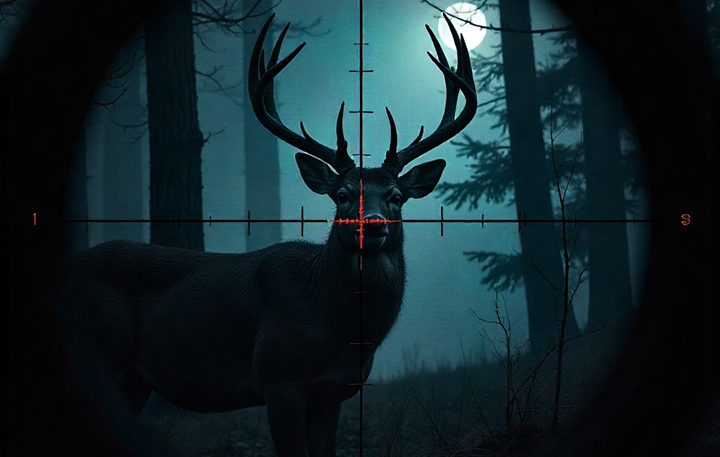
Using your gun at night effectively can only be possible if you have a clear view of your target, and this is where a capable night vision scope comes in. A night vision scope doesn’t illuminate the dark, but takes the scanty illumination present from ambient light, amplifies it, and gives a better image of what would otherwise be just black.
In this guide, we’ll explore the best night vision rifle scopes available today, balancing performance, clarity, and durability to help you make every shot count, no matter how deep the night.
Here is a quick recap;
- DNT Optics Zulus HD V2
- ATN X-Sight 4K Pro
- ATN X-Sight LTV 3-9x30mm
- Pulsar Digisight Ultra N455
- Sightmark Wraith HD 4-32×50
- AGM Spectrum LRF 4K
- AGM Rattler V2 Thermal
Best Night Vision Scope -Reviews
1) ATN X-Sight 4K Pro (Digital day/night scope)
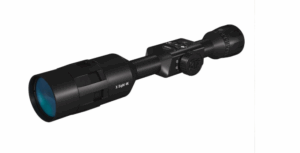
The ATN X-Sight Pro night vision scopes are a feature-rich line of scopes with different magnifications, a 3-14x, and a 5-20x, to help you achieve capable performance in the dark. The ATN X-Sight 4k scopes are versatile, capable of working both during the day and night, delivering great images in both scenarios.
The scopes come with a 4K ultra-HD sensor driving a 1280×720 display, which delivers crisp images in moderate low light, aided by its built-in infrared illuminator for darkness.
An Obsidian IV dual-core processor handles ballistics calculations. Moreover, you get multiple reticle options and onboard 1080p video recording. The “One Shot Zero” system simplifies sighting in by adjusting reticles to the point of impact after a shot.
You’ll also find WiFi and Bluetooth connectivity, a smart rangefinder, and a rugged aluminum chassis. The battery life is rated up to 18 hours, though heavy video or IR use will reduce that.
The scopes offer a powerful mix of smart optics and digital convenience, though, because of the heavy features, they have a learning curve .
Pros
- High resolution 4K sensor with good clarity in low light
- Strong smart features
- Onboard video recording and streaming
- Wi-Fi and Bluetooth connectivity
- Solid build and battery life
Cons
- Night performance in very dark conditions is limited by sensor + IR
- Steep learning curve
2) ATN X-Sight LTV 3-9x30mm
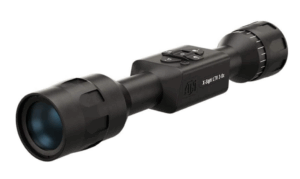
Slightly below the ATN X-Sight Pro is the ATN X-Sight LTV 3-9x30mm. It is rated highly for its potent QHD sensor that gives you crisp images both during the day and night, even though it’s fairly priced.
It provides a clean HD display that makes it easy to identify targets, whether the lighting is bright, dim, or completely dark. The controls are kept simple, and the menu is easy to navigate, making the scope user-friendly even for someone new to digital optics.
One of its standout features is the ability to record video directly to a memory card, allowing shooters to review shots, track performance, or share hunting moments later. The battery life of up to 10 hours is impressive and supports extended shooting sessions without constant recharging.
The aluminum housing is lightweight, durable, and mounts on standard Picatinny rails. While the 3-9x magnification suits short and medium ranges best, the image quality and smooth operation make this scope a strong value in its class.
Pros
- Clear image day and night
- Great value for the price
- Easy-to-use controls and interface
- Long battery life
- Built-in video recording
Cons
- Moderate magnification range
- Lacks some higher-end advanced features
3) Pulsar Digisight Ultra N455
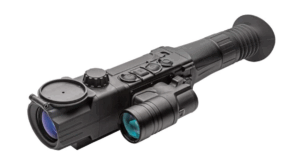
Pulsar’s Digisight Ultra N455 is built around a 1280×720 CMOS sensor and a fast F/1.2 objective lens. It offers a magnification range of 4.5× to 18× with a 4× digital zoom.
The potent sensor paired with a bright AMOLED display and a robust objective lens combination gives excellent image detail for a digital scope.
Pulsar emphasizes detection range and clarity at night, bolstered by a strong built-in IR illuminator. The emitter emits at 940 nm (invisible) to help when ambient light is minimal. This gives a detection range of about 500 meters.
Another big advantage is that Pulsar builds scopes for real hunting conditions. The scope is simple, rugged controls, good recoil tolerance, and long-range detection figures that make this practical for both predator control and practical nocturnal hunting.
Unlike pure image-intensifier tubes, the Digisight shines in adaptability. You can switch between day and night modes, record high-definition video, and use multiple reticle options. Its optical magnification range and digital zoom keep the shooter flexible from mid to longer shots.
Pros
- High sensor resolution (1280×720) and bright objective deliver crisp images
- AMOLED display gives good contrast and color
- Built-in invisible 940 nm IR for improved dark performance
- Decent 500m detection range
- Durable construction
- Firmware upgradability via Stream Vision app
- Ten reticle options and generous memory for recording
Cons
- Image quality degrades with heavy zoom
- Detection range is ideal under perfect conditions
- Fixed internal memory might limit long recording sessions
4) Sightmark Wraith HD 4-32×50
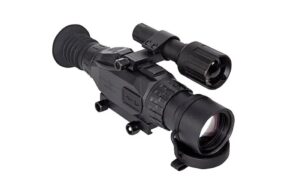
If you want an accessible entry to the digital night vision world, then you need the Sightmark Wraith HD 4-32×50. This is a versatile, value-oriented digital riflescope, designed specifically for shooters who want night capability without a premium price.
The Wraith offers 1080p digital imaging, multi-color reticle choices, and video recording, features more commonly found on higher-end models. Its 4-32x magnification range makes it useful for both short and longer-range shots in varied conditions.
In practice, the Wraith is intuitive, with an easy menu, straightforward zeroing, and a compact form factor. You get full-color imaging during the day; conversely, night images are bright and workable up to moderate ranges, especially when the removable 850 nm IR illuminator is used.
However, being a budget unit, it shows limits in sensor sensitivity and detection distance compared to pricier digital or tube-based systems. Construction is good for the price but not on par with flagship models.
Pros
- Full-color daytime and dual night modes
- 10 reticle styles × 9 color options
- Removable 850 nm IR illuminator for night extension
- External power via micro-USB helps extend runtime
- Rugged aluminum body, .308 recoil rating, IP55 resistance
- Very easy to use
Cons
- Build and optical refinement are mid-tier.
- Shorter effective night detection range than premium units
5) AGM Spectrum LRF 4K
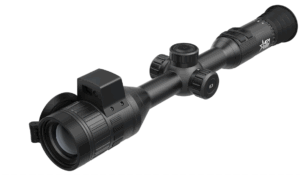
The AGM Spectrum LRF 4K is a highly capable digital riflescope blending full-color day imaging with black-and-white night modes. The scope balances advanced digital features with durability and range support.
Its standout feature is a built-in laser rangefinder (LRF) capable of measuring out to 1,000 meters, which addresses depth perception challenges common in digital optics.
The imaging core is a 3840×2160 (4K) CMOS sensor, paired with a 1920×1080 OLED display to show crisp detail. Its zoom range spans 3.5× to 28×, and the scope includes an adjustable aperture (F1.2–2.5) to optimize low-light performance.
Additionally, it’s packed with extras, which include a ballistic calculator, Shot-Activated Recording (SAR), WiFi streaming via AGM Connect app, 64 GB internal storage, standby mode, and external power capability.
The dual power system uses internal rechargeable batteries plus a replaceable 18650. AGM rates continuous operation at up to 11 hours (with WiFi off). The unit carries an IP67 rating for water and dust resistance.
Pros
- Built-in laser rangefinder to 1,000 m
- True 4K sensor for very high detail
- 5×–28× zoom plus adjustable aperture boosts light gathering
- Up to 11 hours of runtime with dual battery system
- Rugged build with IP67 protection
Cons
- Real night detection in darkness likely falls short of spec’d 1,000 m
- Large size and weight compared to simpler scopes
6) AGM Rattler V2 (Thermal scope)
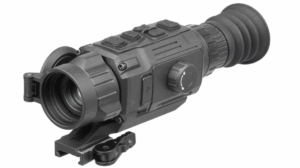
For shooters who prefer thermal scopes over pure night vision, the AGM Rattler V2 is an excellent choice, with great value. Thermal scopes excel in severe darkness, where night vision scopes can only dream.
The AGM Rattler V2 is built for shooters who demand clarity and durability in any environment. It features a 12 µm uncooled VOx sensor paired with a 50 Hz refresh rate, delivering crisp, fluid imagery even in challenging conditions. Detection range extends up to 1,250 yards, giving hunters and professionals reliable visibility well beyond typical night-vision limits.
Additionally, the Rattler V2 includes built-in Wi-Fi, shot-activated recording, and multiple reticle options, allowing users to customize and capture every moment in the field.
Its dual power system offers up to 11.5 hours of runtime, ensuring uninterrupted performance during long sessions. Moreover, the IP67-rated housing provides excellent protection against dust, water, and heavy recoil, making it a rugged companion for any rifle.
While it’s slightly bulky and pricey compared to digital night vision scopes, the Rattler V2 delivers great capability and advanced functionality that justify its cost.
Pros
- High-sensitivity 12 µm sensor with smooth 50 Hz refresh
- 1250 yards detection range
- Wi-Fi, recording, and multiple reticle options
- Long 11.5-hour battery life with dual power system
- Rugged IP67 build, recoil-rated for heavy calibers
Cons
- Slightly heavy and bulky
- Menu system takes time to master
- Detection range varies with the environment
How to Choose the Best Night Vision Scope
Choosing the right night vision scope depends on where, when, and how you plan to use it. Each model has unique strengths, so understanding the main features will help you find one that matches your needs.
Type of Night Vision Technology
Night vision scopes come in three main types. The image intensifier, digital, and thermal. Image intensifiers amplify available light, giving the classic green-tinted image. Digital scopes use sensors to produce high-quality color or monochrome images and often include video recording. Thermal scopes detect heat instead of light, making them effective even through fog, smoke, or brush.
See Also: Generations of night vision explained
Resolution and Image Clarity
A higher resolution means sharper, more detailed images, vital for identifying your target. Digital scopes should ideally have at least 1280×720 pixels, while 1920×1080 or 4K sensors offer even greater clarity. Analog scopes rely on tube generation quality, where higher generations (Gen 2 and Gen 3) deliver superior sharpness and brightness.
Detection and Recognition Range
Detection range shows how far you can spot a target, while recognition range indicates how far you can clearly identify it. Digital scopes often perform best within 200–500 meters, while premium thermal optics may detect heat signatures beyond 1,000 meters. Always choose a range suited to your real-world shooting distance.
Magnification and Field of View
Magnification enhances your ability to zoom in on targets, but excessive zoom narrows your field of view. A balanced setup, such as 4× to 6× optical magnification with moderate digital zoom, works best for most uses. Wide fields of view are ideal for tracking moving game in close terrain.
Infrared (IR) Illuminator Strength
In total darkness, most digital and intensifier scopes rely on an infrared illuminator. A powerful IR extends your visible range, but wavelength matters too. 850 nm IRs offer brighter illumination, while 940 nm IRs are more discreet for hunting.
Battery Life and Power Options
Night vision scopes consume more energy than standard optics, especially when recording or using Wi-Fi. Look for a model offering at least 4–10 hours of runtime, or one that supports external power banks. Dual-battery systems and USB power options are valuable for extended outings.
Build Quality and Durability
A sturdy housing protects your investment. Choose scopes made from aluminum or magnesium alloy, with IP-rated waterproofing and shock resistance for recoil. A rugged build ensures consistent performance in rain, humidity, or harsh terrain, essential for reliable zero retention.
Ease of Use
User-friendly controls are crucial when operating in low light. Simple menus, responsive buttons, and one-shot zeroing features save time and reduce frustration. A clear display with easy brightness adjustment ensures visibility without overwhelming glare at night.
Weight and Mounting Compatibility
Consider the overall balance of your rifle. Lightweight scopes are easier to handle for long periods, while heavier models may add stability for bench shooting. Also ensure compatibility with your rifle’s mounting system.
FAQs
What’s the difference between night vision and thermal scopes?
Night vision scopes amplify existing light, such as moonlight or infrared, to produce a visible image, often in green or black-and-white. Thermal scopes, on the other hand, detect heat signatures emitted by objects and living beings. This allows thermal scopes to work in complete darkness, fog, or smoke effortlessly.
Can I use a night vision scope during the day?
It depends on the type. Digital night vision scopes are safe for daytime use since they rely on electronic sensors that automatically adjust brightness. However, traditional image-intensifier scopes can be damaged by bright light exposure. Always check the manufacturer’s instructions before using your night vision device in daylight conditions.
Are night vision scopes legal to own and use?
In most countries, night vision scopes are legal for personal ownership and general use. However, some regions restrict their use for hunting or require special permits, especially for thermal optics. Always verify your local wildlife and firearm regulations before purchasing or using a night vision scope in the field.
How far can you see with a night vision scope?
The range depends on the scope’s quality and light conditions. Standard digital night vision typically reaches 200–400 meters, while higher-end thermal models can detect heat beyond 1,000 meters. Using an external IR illuminator can extend the visibility range when the ambient light is extremely low.
Do night vision scopes need infrared illuminators?
Not always, but they help. Infrared (IR) illuminators act like invisible flashlights, enhancing performance in complete darkness
Final Thoughts
Night vision scopes are always a great addition to your gun when you need to use it at night. This article looks at just the most valuable night vision, as well as thermal scopes, you can find on the market to pair with your firearm. These scopes are easily available and are backed by a solid reputation. One cannot go wrong with an ATN X-Sight 4K Pro if you need a capable digital night vision scope.
Related