Long-range shooting has always carried an air of exclusivity. For decades, only the most dedicated marksmen with deep pockets could afford glass capable of reaching out past 500, 800, or even 1,000 yards with confidence.
The good news? Times have changed. Thanks to rapid growth in competitive shooting sports, advancements in manufacturing processes, and an increase in interest in precision rifles, budget-friendly long-range scopes now offer features once reserved for high-end tactical optics.
Today, you no longer need to mortgage your wallet to enjoy precision shooting. Affordable scopes now deliver impressive magnification ranges, reliable tracking, first focal plane (FFP) reticles, and solid turret systems, all at prices within reach for hunters, beginners, and budget-conscious competitors.
In this guide, we’ll review some of the best long-range scopes on a budget, analyze their strengths and trade-offs, and provide a buying guide to help you make a smart decision.
Let’s begin with a brief overview.
- Vortex Diamondback Tactical 6–24×50
- Arken Optics SH4J 6–24×50
- SIG SAUER Tango-SPR 6–24×52 mm
- Monstrum Beast 6-24×50 FFP
- Athlon Argos BTR 6–24×50 FFP
- Leupold VX-5HD 3-15×44
- Primary Arms SLx 4–14×44 FFP
- Bushnell AR Optics 4.5–18×40
- Leupold VX-Freedom 4–12×40
Best Long-Range Scope on a Budget- Reviews
1) Vortex Diamondback Tactical 6–24×50 FFP
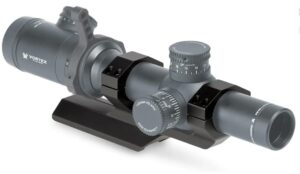
The Vortex Diamondback Tactical has become a benchmark in affordable long-range optics. With a magnification range of 6–24×, it provides flexibility for both mid-range precision and extended-distance shooting. The 50 mm objective lens allows generous light transmission, making it usable even during early mornings or late afternoons when lighting is less than ideal.
One of its biggest advantages is the first focal plane reticle. The EBR-2C reticle stays proportional to the target across all magnifications, meaning your holdovers are always accurate. The turrets feature tactile, audible clicks and hold up well under repeated adjustments. They also track reliably, a critical feature for shooters dialing elevation at distance.
While the glass isn’t comparable to premium optics, it offers more than enough clarity and sharpness for steel shooting or hunting applications. Add to that Vortex’s lifetime warranty, and you have one of the most trusted entry-level long-range scopes available today.
Pros
- Wide magnification range suited for distance shooting.
- FFP reticle keeps subtensions accurate at all zoom levels.
- Solid turret feel with dependable tracking.
- Excellent warranty coverage.
Cons
- Glass clarity declines slightly at maximum magnification.
- Heavier than some competing scopes.
2) Arken Optics SH4J 6–24×50
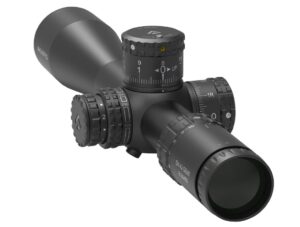
This scope literally stretches your rifle’s range without stretching your budget. It offers a useful magnification range that works well for mid-range practice and long-range shooting, making it versatile rather than overly specialized. The glass delivers a clear, usable image, especially in daylight, and the 50 mm objective helps maintain brightness as magnification increases.
One of its strongest points is the first focal plane reticle, which keeps holdovers and ranging marks accurate at any zoom level, something often missing in scopes at this price. The turrets feel positive and predictable, allowing adjustments to be dialed with confidence, and the zero stop makes it easy to return to a known zero after shooting at distance.
The illuminated reticle is practical rather than flashy, adding visibility when light starts to fade. Build quality feels solid and dependable, with weather sealing that suits range use and field conditions. While it may not match premium optics in refinement, the SH4J focuses on the features that matter most for long-range shooting. That balance of function, durability, and cost is what makes it a strong budget choice.
Pros
- First focal plane reticle with accurate holds at all magnifications
- Wide 6–24× magnification suited for long-range shooting
- Reliable zero stop system
- Clear glass for the price
- Solid, weather-resistant construction
- Excellent feature set for a budget scope
Cons
- Turrets feel functional rather than premium
- Low-light performance is good, not exceptional
3) SIG SAUER Tango-SPR 6–24×52 mm
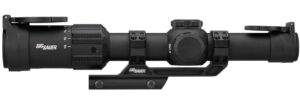
The Tango-SPR features a second focal plane reticle designed for precision dialing. This means the reticle stays the same size as magnification changes, helping shooters make fine corrections when dialing for distance rather than relying on reticle subtensions alone. The zero-stop elevation turret is easy to engage and ensures a reliable return to a known zero after dialing for shots at extended distances. The windage turret is low profile but tactile, reducing the chance of bumping it during movement.
Optically, this scope tends to show good contrast and sharpness, especially in the mid-to-high magnification range where long-range work is most common. The image doesn’t suffer from heavy color fringing, and the clarity makes it easier to spot bullet impacts and read target detail.
The build quality feels rugged and dependable, with waterproof, fog-proof, and shock-resistant design that stands up to regular range use. While it doesn’t match the ultra-premium clarity of top-tier optics, it clearly outperforms many entry-level offerings in the same price category.
Pros
- Brighter, clearer glass than many budget competitors
- 6–24× magnification ideal for long-range shooting
- Zero-stop elevation turret simplifies dialing and return to zero
- Smooth, reliable turret feel
- Strong mechanical build with good weather resistance
Cons
- Eye box can feel restrictive at maximum magnification
- Heavier than minimalist options.
4) Monstrum Beast 6-24×50 FFP Review
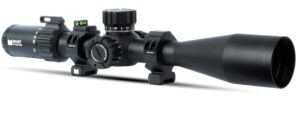
The Monstrum Beast 6-24×50 FFP is designed for shooters who want advanced long-range features without spending premium prices. Built around a first focal plane (FFP) reticle, this scope ensures that holdovers and range estimations remain accurate throughout the entire magnification range. That’s a big deal for precision shooters because you don’t need to recalculate holdovers at different zoom levels what you see at 6x is the same at 24x.
The 50mm objective lens allows plenty of light transmission, giving you clearer images even during low-light conditions such as dawn or dusk. Monstrum also includes an illuminated reticle, which provides better visibility against dark backgrounds, and multiple brightness settings so you can fine-tune to your environment.
Another standout feature is the zero stop elevation dial, letting you quickly return to your original zero after dialing for distance. The turrets are tactile and audible, making adjustments straightforward and reliable. Despite its budget price point, the Beast is surprisingly rugged, built from aircraft-grade aluminum with nitrogen purging to resist fog and water.
For hunters and target shooters on a budget who need reliable long-range performance, the Monstrum Beast is a very compelling choice.
Pros
- First focal plane reticle
- Illuminated reticle with multiple brightness settings
- Zero stop elevation dial for fast return-to-zero
- Large 50mm objective lens
- Great value for money
Cons
- Glass clarity is good but not as refined as higher-end brands
- Turrets may feel less crisp
5) Athlon Argos BTR 6–24×50 FFP
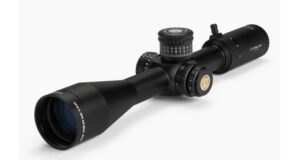
Athlon has quickly gained a loyal following in the budget optics space, and the Argos BTR demonstrates why. This scope packs features typically found in mid-tier optics at a fraction of the price. The 6–24×50 configuration makes it versatile, while the FFP reticle ensures precision holdovers and range estimations across the magnification spectrum.
Turret design is another highlight. The Argos BTR includes crisp adjustments and often a zero-stop function, a feature usually reserved for pricier optics. Its reticle options, in both MOA and MIL versions, allow shooters to choose the system they’re most comfortable with.
The glass is surprisingly clear for the price point, particularly in the center. At high magnification, edge clarity may fall off slightly, but for the cost, it performs far above expectations. For budget-conscious shooters who still demand competitive features, the Argos BTR is a standout.
Pros
- Excellent feature-to-price ratio.
- Available in both MOA and MIL reticle versions.
- Zero-stop system on many models.
- Rugged and reliable construction.
Cons
- Eyebox can be unforgiving at higher magnifications.
- Focus and parallax adjustments may feel slightly stiff.
6) Leupold VX-5HD 3-15×44 mm Review
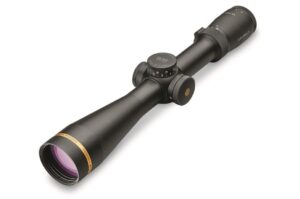
The Leupold VX-5HD 3-15×44 packs a lot of long-range-capable features into a relatively compact and rugged package. Its magnification range (3× at the low end up to 15×) gives shooters the flexibility to engage targets at lower magnification for quick acquisition or stalking, while still having enough zoom to dial into longer distances, say, 600-800 yards, depending on your rifle and conditions.
The 44 mm objective strikes a good balance, without becoming too bulky or heavy to mount or carry. Optically, the “HD” designation means better lens glass and coatings relative to a simpler lens.
The scope offers excellent reticle options, often including illuminated reticles (in low light variants) and various MOA or MIL hash patterns depending on model, giving users a choice to match their ballistic style. Reticle subtensions are well behaved, though this model is not first focal plane, so the accuracy of hash marks holds only at the magnification for which they are calibrated.
Turrets are solidly made, with crisp clicks, smooth travel, and dependable return to zero. Parallax adjustment is included and works cleanly, though at the long end, it takes a bit of dialing to get exact clarity. Build quality is excellent; sealed against weather/fog, durable finishing, and firm mounting footprint.
Pros
- Good magnification flexibility (3-15×)
- High-quality “HD” glass and coatings
- Durable build quality
- Different reticle options
- Manageable weight.
Cons
- Some people prefer FFP for long range targets
- Less crisp at 15x
7) Primary Arms SLx 4–14×44 FFP (ACSS HUD DMR Reticle)
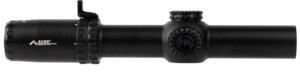
Primary Arms is known for bringing innovative reticles to the budget market, and their ACSS HUD/DMR design is particularly well-suited for long-range shooting. The reticle provides built-in ballistic holdovers, wind holds, and range estimation tools, all of which simplify shot calculations and reduce time between target acquisition and firing.
The 4–14× magnification range isn’t as high as some competitors, but it’s plenty for most real-world long-range needs. At 14×, shooters can comfortably engage targets out to 600–800 yards depending on conditions. The FFP design keeps all subtensions accurate regardless of zoom.
Tracking is consistent, and the build is rugged enough for field conditions. While the glass isn’t high-end, it provides adequate clarity for steel targets and hunting. This scope is perfect for shooters who value reticle functionality and quick engagement over sheer magnification power.
Pros
- Innovative ACSS HUD/DMR reticle for practical long-range use.
- Accurate FFP subtensions at all magnifications.
- Affordable while still providing serious features.
- Ideal for hunters and PRS-style beginners.
Cons
- Max magnification of 14× may limit extreme-range shooters.
- Reticle can feel busy to some shooters.
8) Bushnell AR Optics 4.5–18×40
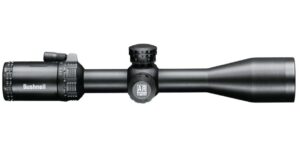
Bushnell’s AR Optics line has long been a go-to for shooters looking for dependable, affordable glass. The 4.5–18×40 is an excellent budget-friendly long-range scope, striking a balance between magnification, weight, and price. The exposed turrets provide tactile adjustments, and the reticle options (often BDC or MIL-style) give shooters a functional system for ranging and holdovers.
This scope is particularly well-suited for AR-platform rifles but also works nicely on bolt-action hunting or target setups. The 18× top end provides enough magnification for most long-range engagements while still keeping the optic relatively lightweight and portable.
While the glass is mid-tier and not designed for professional competition, it holds its own at the price point. Its durability and ergonomics make it a favorite among hunters and recreational shooters alike.
Pros
- Good magnification range for hunting and range use.
- Lightweight and manageable for field carry.
- Dependable turret system.
- Affordable price point.
Cons
- Glass clarity is decent but not premium.
- Parallax adjustment could be smoother.
9) Leupold VX-Freedom 4–12×40
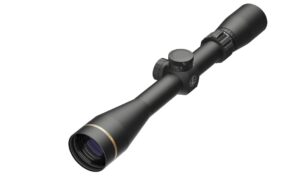
Leupold is synonymous with reliability, and their VX-Freedom line brings that legendary durability into the budget realm. The 4–12×40 isn’t the highest-magnification scope on this list, but it’s an excellent option for hunters who want a dependable optic that can stretch shots when needed.
The glass is bright and clear, particularly for the price, and Leupold’s coatings provide solid performance in low-light conditions. The reticle options are simple, often a Duplex or BDC-style, making it easy for hunters to use without clutter.
The VX-Freedom isn’t built for tactical competitions, but for hunters or casual shooters who occasionally stretch to longer ranges, it’s a trusted companion. Plus, it carries Leupold’s lifetime guarantee, adding peace of mind.
Pros
- Lightweight and field-friendly.
- Bright, clear glass with excellent coatings
- Legendary Leupold durability and warranty.
- Simple, uncluttered reticle options.
Cons
- Limited top-end magnification compared to other scopes.
- Lacks advanced features for precision competition.
Budget Long-Range Scope Buying Guide
Here are the factors to consider when shopping for a long-range scope.
Magnification Range
Magnification determines how flexible your scope will be. Higher ranges (like 6–24×) are great for long-range target work, while moderate ranges (4–12×, 4–14×) are better for hunters who need versatility. Too much magnification can reduce the field of view and exaggerate mirage, so balance is key.
Reticle Type
FFP reticles keep subtensions accurate across all zoom levels, making them preferred for precision shooting. SFP reticles can work well if you primarily shoot at a set magnification. Consider whether you want a simple Duplex, a BDC, or a detailed MIL/MOA grid reticle.
Turret Quality
Turrets should be tactile, repeatable, and capable of returning to zero. Look for zero-stop functions if possible, as they save time and prevent dialing mistakes. Decide between MOA or MIL systems based on what you’re comfortable with.
Glass Quality
Clarity, brightness, and color fidelity matter at long distances. Budget scopes won’t rival $2,000 optics, but some provide excellent performance for the money. Pay attention to center sharpness and low-light capabilities.
Parallax Adjustment
Parallax error can ruin long-range precision. A side parallax knob or adjustable objective helps align the reticle with the target at varying distances. Ensure the adjustment is smooth and covers the ranges you plan to shoot.
Durability and Warranty
Scopes face recoil, weather, and field abuse. Look for nitrogen purging, waterproofing, and durable materials. A strong manufacturer warranty adds significant value, ensuring you’re covered if issues arise.
Weight and Size
Heavier scopes can affect rifle balance, which matters for hunters covering long distances on foot. For target rifles, extra weight is less of an issue. Match your optic’s size and weight to your intended use.
Frequently Asked Questions (FAQs)
Do I really need a first focal plane scope for long-range shooting?
Not always. FFP scopes are preferred for serious long-range shooters because reticle subtensions remain accurate at all magnifications. However, SFP scopes can still perform well if you consistently shoot at the magnification where subtensions are calibrated. Hunters or casual shooters may find SFP more affordable and sufficient.
What magnification is best for shooting at 1,000 yards?
While 20–25× is often ideal for spotting small targets at extreme distances, many shooters find that 10–15× is perfectly usable for 1,000-yard shots. Higher magnification can be helpful but isn’t always necessary. Clear glass, good fundamentals, and a solid rest are often more important.
Are budget scopes reliable enough for competitive shooting?
Yes, many budget scopes perform surprisingly well in entry-level competitions. Features like FFP reticles, zero-stop turrets, and repeatable tracking can be found at affordable prices. While professionals may prefer premium optics for marginal advantages, a well-chosen budget scope is more than capable of getting you started.
Should I choose MOA or MIL adjustments?
Both systems work, but consistency is key. MIL (milliradian) is increasingly popular in competitions due to its simpler decimal system, while MOA (minute of angle) is still common among hunters in the U.S. Match your turrets and reticle to the same system, and stick with the one that feels most intuitive to you.
How important is turret tracking in a budget scope?
Extremely important. At long range, even small errors in adjustment can cause misses. Reliable turret tracking ensures that when you dial for elevation or wind, the reticle movement matches your calculations. This is a feature you should never compromise on, even in a budget optic.
Can a budget scope handle magnum calibers?
Many can, as long as they are built with strong erector systems and quality materials. However, not all budget scopes are recoil-rated for magnum cartridges. Always check the manufacturer’s recommendations, and if in doubt, consider a scope with a reputation for durability like SWFA or Leupold.
How do I know if my scope has parallax issues?
If your reticle appears to move against the target when you shift your head slightly, parallax is present. At long ranges, this can throw off your shot significantly. Using the parallax adjustment to bring the target and reticle into the same optical plane solves this problem.
Conclusion
The world of optics has opened up to budget-minded shooters in ways that were unthinkable just a decade ago. Today, you can buy a long-range scope for under $500–$700 that tracks well, offers FFP reticles, and provides usable clarity at magnifications once reserved for premium optics.
The key is understanding your needs, choosing a scope that aligns with your shooting style, and practicing fundamentals to get the most from your glass. With the right scope, you’ll discover that stretching shots to 600, 800, or even 1,000 yards is more accessible than ever without emptying your wallet.
See Also: Good scopes for 300 yards