
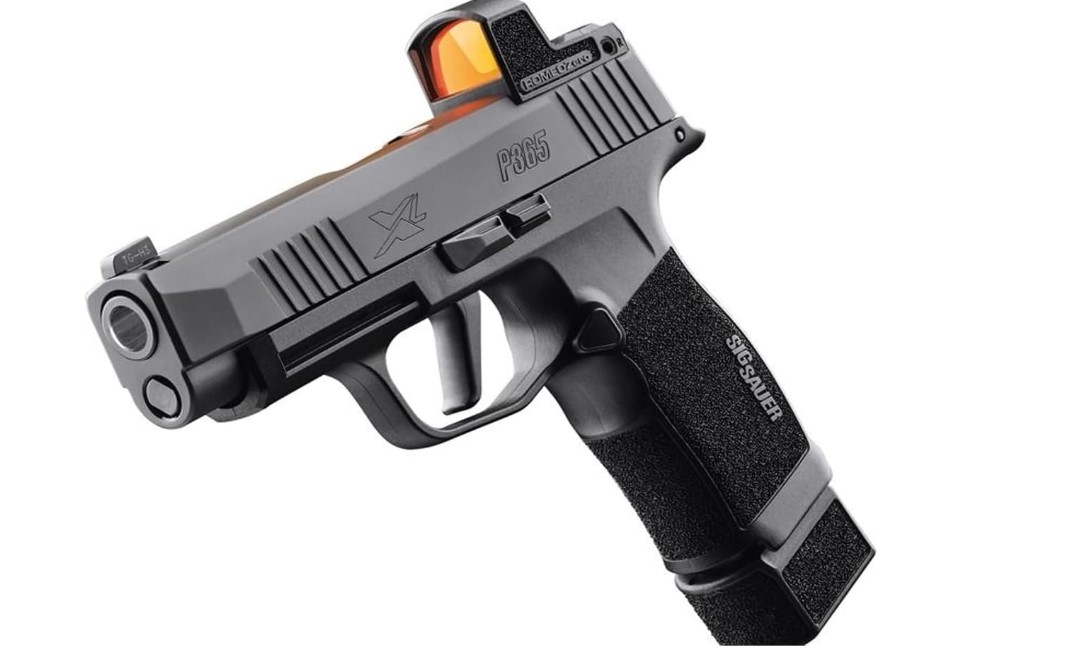
The SIG P365 XMacro is a compact powerhouse, concealable enough for daily carry, yet large enough to accept a variety of optics that turn point-and-shoot into point-and-click precision.
That versatility has created a crowded market of tiny reflex sights all promising clarity, battery life, and rock-solid reliability.
If you’re shopping for the best red dot for a P365 XMacro, you want something that balances size, sight picture, durability, and mounting convenience, and that’s exactly what this article delivers.
Below you’ll find deep, original reviews of top red dots that work well on micro and compact pistols like the XMacro.
First, the summary
- Aimpoint ACRO P-2
- SIG Sauer ROMEOZero
- Holosun 407K X2
- Trijicon RMR Type 2
- Leupold DeltaPoint Pro
- Shield RMSc
- Vortex Viper red dot
Best Red Dot for P365 XMacro- Reviews
1) Aimpoint ACRO P-2
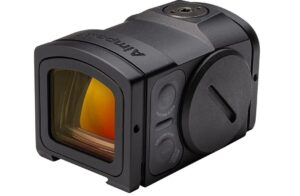
The Aimpoint ACRO P-2 isn’t just another micro red dot; it’s a pistol optic built with durability as its foundation. The standout feature is its 3.5 MOA red dot reticle, which strikes the perfect middle ground between speed and precision.
A reticle of this size is quick to acquire under stress, yet fine enough for deliberate accuracy at longer handgun distances. What makes the ACRO P-2 truly special is its enclosed emitter design. Unlike open reflex sights that can get blocked by rain, dust, lint, or mud, the P-2’s optical system is fully sealed. This means you get a clean, usable aiming point no matter the environment.
Battery life is another leap forward. Aimpoint upgraded from the older P-1’s CR1225 to a CR2032 battery, giving an astonishing 50,000 hours of runtime on medium settings. That’s over five years of constant-on capability, so you can realistically leave the sight running indefinitely without worrying it will quit on you in the middle of a critical moment.
Even better, the side-loading battery compartment means you don’t have to remove the optic (and risk losing zero) when swapping cells. The housing is machined from high-strength aluminum and designed to take punishment, drops, recoil, and exposure to water or extreme cold/heat won’t throw it off.
Pros
- 5 MOA reticle balances rapid target acquisition with fine precision.
- Rugged, fully enclosed emitter
- Massive battery life
- Side-loading battery allows easy replacement.
- Ten brightness settings, including night-vision modes.
Cons
- Larger and heavier than slim micro dots.
- pricey
2) SIG Sauer ROMEOZero
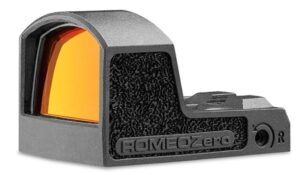
The ROMEOZero was designed with compact striker-fired pistols in mind. Tiny footprint, extremely low profile, and a reticle optimized for fast target acquisition.
If you like the idea of an optic engineered by the same company as your pistol, the ROMEOZero often feels like the most natural fit. It mounts very low and is engineered to preserve the pistol’s natural sight line and concealability, two priorities for many XMacro users.
The sight’s window is small but crisp; in practical terms, that means a clear, unobstructed dot at typical self-defense distances. Controls are straightforward, typically with two buttons for brightness and a mechanical on/off, simple, fast, and intuitive when you’re under stress.
Performance-wise the ROMEOZero offers a balance between weight and toughness. It’s lightweight enough not to upset the pistol’s balance while still robustly sealed against the elements.
Battery life is commonly reported as good for the size class (hours to thousands of hours depending on brightness settings), and the sight performs consistently with quick target acquisition for both slow, precise shots and faster emergency strings.
The ROMEOZero also plays nicely with suppressor-height or slightly raised sights if you plan to retain iron backups. That said, if you demand the absolute smallest window or the longest battery life in the category, there may be contenders that beat it in one area or another, but for a no-fuss, pistol-first design, the ROMEOZero is a compelling, practical choice.
Pros
- Designed for compact pistols
- Crisp, easy-to-acquire dot at typical defensive ranges.
- Intuitive controls and reliable sealing against the weather.
- Durable build quality
Cons
- Window is smaller than some competitors
3) Holosun 407K X2
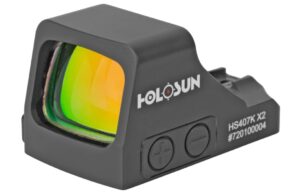
Holosun’s 407K X2 blends modern features into a pistol-sized footprint: solar assist, multiple brightness settings, long battery life claims, and Holosun’s familiar reticle options.
For shooters who want advanced functionality in a tiny sight, like an extended battery life mode combined with a backup solar top-off, this line is very attractive.
The optic’s housing is compact and designed to minimize snag, while the window remains generous for a pistol-class red dot, giving a nice field of view for both target acquisition and transitions between nearby targets.
Many users appreciate Holosun’s faint reticle options and the easy-to-manage brightness controls. The battery compartment and battery life management systems are typically user-friendly, and the sight’s multi-path illumination (solar + battery) makes it forgiving if you occasionally forget to swap the CR1632 or similar cell.
Durability is solid for everyday carry, though in pistol-class optics, there’s always a tradeoff between the thinnest possible profile and ultimate ruggedness. With Holosun, you often gain more features per dollar than many competitors, making the 507K series an excellent midrange pick for XMacro owners who want tech without a huge price tag.
Pros
- Solar assist plus battery extends usable uptime.
- Generous window for a compact reflex.
- Competitive feature set and value.
- Decent multilayer glass
Cons
- Slightly taller footprint
- Some users report sensitivity to harsh impacts
- Menus take a minute to get used to
4) Trijicon RMR Type 2
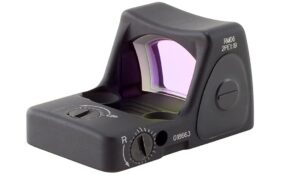
Trijicon’s RMR (Ruggedized Miniature Reflex) has been a go-to optic for duty and competition for years. The Type 2 iteration refined battery access, electronics, and durability.
The RMR is built like a tank for its size, with machined housing, proven mounts, and widespread aftermarket availability.
For P365 XMacro owners who put reliability above all else, the sort of buyer who wants to know the dot will survive a drop, heavy recoil, or a long deployment, the RMR is hard to beat.
Optically, the RMR’s window is small but sharp; the dot shapes are clean, and the illumination is strong. Battery life varies by model and dot brightness, and the Type 2 brought a more serviceable battery cap for faster swaps.
The tradeoffs for that durability are price and a taller profile than the absolute smallest pistol-specific red dots. Also, because the RMR has become the industry benchmark, there’s an enormous ecosystem of mounts and adapter plates, which helps P365 XMacro owners adapt the sight to their slide without custom work in many cases.
Pros
- Extremely rugged and proven in demanding environments.
- Clean, crisp dot and mature product ecosystem.
- Wide aftermarket support for mounting solutions.
Cons
- Generally pricier than comparable compact reflexes.
5) Leupold DeltaPoint Pro
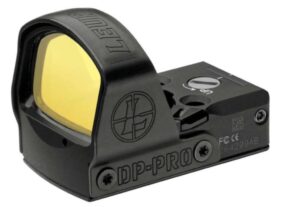
The DeltaPoint Pro stands out because it emphasizes a larger viewing window and a broad field of view. For shooters who prefer rapid target acquisition and a very liberal sight picture — handy in low-light or dynamic target situations, the DeltaPoint Pro is a compelling choice. It’s slightly larger than the tiniest pistol-class dots, but that extra glass often translates into faster alignment and better awareness of the target environment.
Leupold’s glass clarity and reticle crispness are strong points; the dot is well-defined and Leupold’s brightness controls are easy to use under stress.
Durability is excellent for the class, and Leupold’s reputation for optical quality shows through. The footprint may not always match every micro slide without an adapter plate or appropriate slide milling. If you favor speed and field of view over the minimal profile, the DeltaPoint Pro offers a tangible advantage in quick sight acquisition and situational clarity.
Pros
- Large window and expansive field of view for faster acquisition.
- Excellent glass clarity and crisp dot.
- Solid durability and easy-to-use controls.
Cons
- larger footprint may require an adapter plate or slide work.
- Slightly heavier and bulkier than the absolute smallest pistol red dots.
6) Shield RMSc
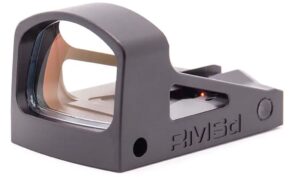
Shield’s RMSc (and RMS family) were specifically designed with micro-compact pistols in mind. They emphasize a shallow profile, lightweight construction, and a very compact footprint.
For P365 XMacro owners seeking minimal concealment disruption and a near-sightline experience, Shield’s models are tailored to meet those demands. The optics are straightforward: simple dot options, reliable brightness settings, and a nearly unobtrusive silhouette on the slide.
While Shield’s window size is modest, they prioritize low-profile geometry so the optic doesn’t change how the pistol carries or prints.
Shield sights are often praised for being user-serviceable (battery changes, basic adjustments) and for delivering dependable performance without excess complexity. They sit well in the pocket or holster because they’re slim. On the flip side, you’ll sacrifice some field of view and perhaps the most premium glass clarity you’d get from higher-priced competitors, but you’ll gain concealability and a sight that feels like an integrated part of your pistol, not an add-on.
Pros
- Extremely low profile and slimline design for concealment.
- Simple, intuitive operation and reliable performance.
- Lightweight and unobtrusive on the slide.
Cons
- Smaller window and less expansive field of view.
- Not the brightest or most feature-rich sight available.
7) Vortex Viper red dot
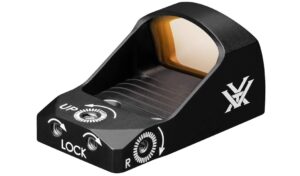
Vortex has built a reputation for offering feature-rich optics at accessible prices, and their pistol-class red dots reflect that approach. The Viper models are valued by shooters who want a high-quality optical experience without the premium cost.
These sights typically offer a clear dot, straightforward battery access, and a reputable warranty and customer service program, something many budget optics skimp on.
If you’re balancing cost against performance, a Vortex compact red dot can be a strong compromise. Well-made, optically honest, and backed by a company that stands behind its gear.
The footprint and profile vary by model, so plan for a possible adapter plate or slide work for perfect fitment to the XMacro.
Expect a solid performance in everyday carry situations, with slightly less refinement in housing machining and electronics compared to the highest-tier boutique sights. For value-focused buyers, Vortex is hard to ignore.
Pros
- Strong value.
- Backed by Vortex’s customer service and warranty.
- Clear dot and easy battery access.
- Quick 6 MOA reticle
Cons
- Not as compact as the smallest pistol-specific sights.
- Slightly less robust housing than premium competitors.
How to choose the best red dot for your P365 XMacro
These are just the things to look for when shopping for a red dot for a P365 Xmacro
Footprint & Compatibility
Different red dots use different footprint patterns for mounting. The P365 XMacro’s slide may be machined to a particular footprint or require an adapter plate.
Before buying, verify which footprint your slide accepts or whether you’ll need a specific adapter plate or gunsmithing. Choosing a sight that matches the slide’s cut saves time and expense; if you buy a sight with a different footprint, factor in the cost and lead time for an adapter plate or slide milling.
Profile & Window Size
There’s a tradeoff between a low profile (good for concealment and draw) and a larger window (good for speed and field of view). If concealability is paramount, prioritize low-height, slim optics. If rapid target acquisition and situational awareness are more important, choose a model with a larger window. Evaluate how much you value the pistol’s original sightline versus how much visual real estate you want for fast shots. Try to visualize how the optic will look in your holster and during transitions.
Dot Size & Reticle Options
Dots come in sizes like 1 MOA, 3 MOA, and 6 MOA, and some sights offer multiple reticle options (dot, circle-dot, etc.). Smaller dots are better for precision at distance; larger dots can be faster to pick up under stress or on close targets.
Think about your typical engagement distance and whether you prioritize precise sighting for longer shots or instinctive hits in the 3–25-yard range. Multi-reticle sights give flexibility, but they can add complexity and slightly more electronic overhead.
Battery Life & Power Options
Tiny red dots use small coin batteries with lifespans that vary widely based on brightness settings and electronics. Some sights include solar assist or motion sensors to extend life, and some have auto-off features.
If you’re the kind of shooter who may forget to turn the optic off or who needs rock-solid uptime, prioritize sights with long battery life, easy battery access, or solar topping. Think about how often you train. If you put a lot of rounds through the gun weekly, battery change frequency matters.
Durability & Construction
Pistol optics must stand up to repeated recoil, drops, and environmental exposure. Higher-end sights use more robust materials and thicker housings; some have military-grade certifications.
If you carry daily or expect harsh conditions, invest in a sight with a proven rugged reputation. If your use is occasional or recreational, you can lean toward lighter or more budget-friendly options. Remember: durability also includes quality of mounting and screws, a solid mount is as important as the sight housing.
Ease of Use & Controls
Can you change the brightness with gloves? Are buttons easy to find under stress? Are windage/elevation adjustments intuitive? Controls matter more than people first assume. In a defensive scenario, you want tactile, unambiguous buttons or dials, and an adjustment system you can operate without tools. Some sights place the controls in awkward spots for certain holsters or hand positions; consider how you carry and draw when assessing control placement.
Iron Sight Compatibility
Decide whether you’ll keep iron sights as backups and whether you want co-witnessing (using irons with the dot). Some optics position the dot so that co-witness is straightforward; others are lower or could block irons entirely.
If you prefer to use suppressor-height sights or to retain a visible rear/front setup, ensure the dot’s mounting height and footprint let you achieve that. Also, check whether existing irons on the pistol will align naturally with the optic or require upgraded sights.
Aftermarket Support & Warranty
A good warranty and responsive customer service reduce stress if anything goes wrong. Also consider the availability of adapter plates, protective covers, mounting screws, and service parts.
Some brands have huge ecosystems, which makes customizing and repairing easier. If you plan to sell or upgrade later, brands with broad aftermarket support often retain higher resale and have more users sharing real-world experience online.
Frequently Asked Questions (FAQs)
Will any red dot fit a P365 XMacro?
Not every red dot will mount directly to every P365 XMacro slide. Slides accept specific footprint cuts, and some P365 XMacro slides are pre-cut for certain patterns, while others may require adapter plates or slide milling.
Before you purchase, identify the footprint of both your slide and the sight. If your chosen sight uses a different footprint, confirm that a compatible adapter plate exists or that you’re comfortable having the slide milled to accept the optic.
Do I need to change my iron sights when adding a red dot?
You don’t always have to change irons, but it depends on the optic’s height and whether you want co-witness. If you want to use iron sights as a visible backup through the optic, install taller suppressor-height iron sights or ensure the optic’s height gives the desired sight picture.
For some low-profile pistol dots, iron sights will sit below the window and won’t co-witness effectively, so shooters often install higher backup sights or carry with the understanding that irons are secondary.
What dot size should I choose?
A 3 MOA dot gives finer precision at longer distances, making it good if you shoot at 15–50 yards and value accuracy. A 6 MOA dot is easier to pick up quickly at close range and may be preferable for defensive scenarios where speed matters more than pinpoint grouping.
Many shooters settle on a 3 MOA or 3–6 MOA compromise for carry pistols because it balances precision and speed. Think about your primary use: target work vs. close defensive encounters.
How often should I zero my red dot?
Zeroing stability depends on the sight and its mounting. After you install a new red dot, verify zero after the first few rounds and again after a larger session (100–200 rounds) because mechanical seating can settle.
Periodically check the zero after cleaning, heavy impacts, or if you notice a change in the point of impact. For carry guns, a quick function check and occasional two-shot verification at short range is a good habit to ensure the optic remains properly zeroed.
How does the P365-XMacro compare to Glock?
The SIG P365 XMacro is a compact, high-capacity striker-fired concealed-carry pistol with excellent ergonomics and optics-ready slides, prioritizing concealability.
Glock pistols are larger-platform, widely modular, and renowned for simplicity, aftermarket support, and durability. Choose XMacro for compact capacity; choose Glock for proven reliability, parts availability, customization, and long-term resale.
Can I leave my red dot turned on all the time?
Some shooters do, and some don’t. Leaving a dot on continuously drains battery faster, but many modern sights have motion sensors or auto-shutoff features to extend battery life. Solar-assisted sights can top off in daylight.
If you’re forgetful, consider a sight with auto-shutoff or motion activation, or plan regular battery checks. Also, leaving a sight on for months will ultimately require battery replacement, but many carry optics have multi-thousand-hour life spans on conservative settings.
Is it better to get the sight that fits without modification or pay for slide milling?
If you can buy a sight that fits your slide’s factory footprint, it’s usually simpler and cheaper. However, custom milling can provide the ideal mount and sight height, and some shooters prefer a particular sight so much that they choose to have the slide milled.
Evaluate the cost, but typically, adapter plates are often less expensive than milling. Plates, however, change the optic’s height slightly. If you want a factory-level fit and are comfortable with gunsmithing expense, milling can be the optimal long-term solution.
Final thoughts
Whatever red dot sight you choose for your P365 Xmacro, verify footprint compatibility with your slide, think about iron sight strategy, and plan for the real-life costs of mounting and battery upkeep. Try to handle or demo a sight if possible.
The way the controls feel and how the sight aligns with your draw can be surprisingly personal. With the right red dot paired to the P365 XMacro, you’ll gain speed, confidence, and a better sight picture, tools that pay dividends whether you’re on the range or carrying for protection.
Related