
Your AR-15 is one of the most capable rifles ever designed, and it deserves an optic that can keep up. A quality red dot sight transforms how quickly and precisely you get on target. The problem? The market is flooded with options at every price point, and not all of them are worth mounting on a serious rifle.
We’ve dug deep into six of the most popular and well-regarded red dot and holographic sights for the AR-15 platform, from budget-friendly picks to professional-grade optics trusted by military and law enforcement. Each review covers performance, durability, value, and why it matters specifically for an AR owner. Here’s what you need to know before you buy.
| Sight | Features |
Aimpoint PRO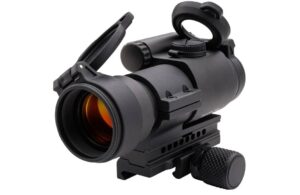 |
Get it on Amazon | Opticsplanet |
Aimpoint Micro T-2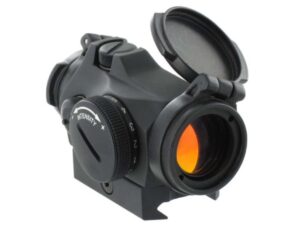 |
Get it on Amazon | Opticsplanet |
| EOTech EXPS3
|
Get it on Amazon | Opticsplanet |
| Trijicon MRO
|
Get it on Amazon | Opticsplanet |
| SIG SAUER ROMEO5
|
Get it on Amazon | Opticsplanet |
| Holosun 510C
|
Get it on Amazon | Opticsplanet |
Best Red Dot Sights for AR 15 -Reviews
1) Aimpoint PRO (Patrol Rifle Optic)
If reliability is non-negotiable for your AR-15, the Aimpoint PRO (Patrol Rifle Optic) belongs at the top of your list. Designed specifically with law enforcement and serious civilian shooters in mind, this sight runs on a single AA battery for an incredible 30,000 hours, that’s roughly three years of continuous use. You can leave it on and never think twice about it.
The 2 MOA dot is crisp, parallax-free, and co-witnesses perfectly with standard AR iron sights when used with the included QRP2 mount. It’s fully night-vision compatible and shrugs off rain, dust, and hard recoil without complaint. The aluminum body is submersion-rated to 150 feet, and the internal adjustments are precise and repeatable, exactly what you want when zeroing for the first time or confirming zero after transport. For the price, you’re getting a sight that rival agencies and militaries worldwide trust with their lives, and that should mean everything to an AR owner who wants dependability without paying a premium price. The Aimpoint PRO simply does not fail when it matters most.
Pros
- 30,000-hour battery life on a common AA
- QRP2 mount included
- Submersion-rated to 150 feet
- Night-vision compatible out of the box
- Proven by law enforcement worldwide
Cons
- Heavier than compact alternatives at 7.8 oz
- Bulkier profile on lightweight AR builds
- Only 2 NV brightness settings
2) Aimpoint Micro T-2
The Aimpoint Micro T-2 is widely considered the gold standard of compact red dot sights, and for good reason. Used by special operations forces across multiple countries, this sight punches far above its diminutive size. The 2 MOA dot is tack-sharp with zero distortion and offers 12 brightness settings, including 4 dedicated night-vision positions, giving you full adaptability from daylight to pitch-dark conditions.
At just 3.7 ounces without a mount, it adds virtually nothing to your AR-15’s handling characteristics while delivering a field of view that stays wide and instinctive at close range. The T-2’s advanced lens coating significantly reduces lens glare compared to its predecessor, the T-1, which means better target acquisition in bright or backlit scenarios. The housing is built to withstand environments that would destroy lesser optics, intense cold, sand, saltwater, and sustained automatic fire recoil all included. If your AR is a serious tool and budget is secondary to performance, the Micro T-2 is the optic you buy and never replace. It is, simply put, as close to perfect as compact red dots get.
Pros
- Extremely lightweight
- Outstanding battery life
- Exceptional durability
- Crystal-clear glass
- Excellent with magnifiers
Cons
- Expensive
- Mount often sold separately
- Small window for some shooters
3) EOTech EXPS3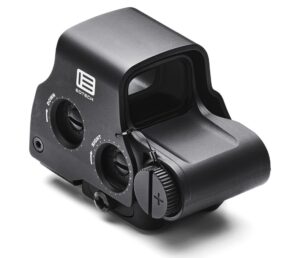
The EOTech EXPS3 isn’t technically a red dot, it’s a holographic sight, and that difference is immediately apparent the moment you look through it. The 68 MOA ring with 1 MOA dot reticle is burned into your field of view in a way that feels completely natural, giving your AR-15 an aiming system that works with your instincts rather than requiring you to align a dot on a glass lens. This makes it devastatingly effective at close-to-medium ranges where speed of acquisition is life.
The EXPS3 uses a CR123A battery and includes two night-vision-compatible brightness settings below standard, meaning it pairs beautifully with a magnifier or NODs for a versatile setup. The side-loading battery compartment is a thoughtful design choice that allows you to swap batteries without removing a magnifier. The body is machined aluminum, waterproof, and fog-proof. The large viewing window gives you outstanding situational awareness, you see the entire field, not just through a tube. For AR owners who run their rifles hard in defensive or competitive roles, the EXPS3 elevates your performance in ways a standard dot simply cannot.
Pros
- Extremely fast reticle acquisition
- Large viewing window
- Excellent for tactical shooting
- Superb magnifier compatibility
- Night vision compatible
Cons
- Shorter battery life
- Heavier than micro optics
- Premium price
4) Trijicon MRO
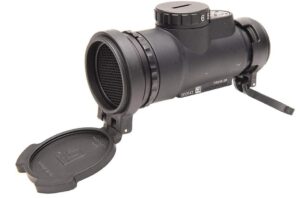
Trijicon has a hard-earned reputation for making optics that never quit, and the MRO (Miniature Rifle Optic) continues that tradition while bringing something genuinely new to the table: a wider, tapered objective lens housing that gives you exceptional field of view for a compact red dot. That wider window makes it noticeably easier to acquire your target under stress, a crucial advantage when your AR is in your hands for defensive purposes.
The 2 MOA dot is clean and precise, running on a single CR2032 coin battery for up to five years of continuous use at standard settings outstanding battery efficiency for its class. The housing is aircraft-grade aluminum and covered under Trijicon’s legendary lifetime guarantee. The MRO runs on a simple one-dial brightness adjustment with seven settings, two of which are night-vision compatible. It co-witnesses with AR-15 iron sights and accepts standard lower-third and absolute co-witness mounts.
Features
- Dot Size: 2MOA
- Battery-life: 5-years
- Weight: 4.1 Oz.
- Night-Vision: 2NV modes
Pros
- Wide field of view
- Lightweight design
- Strong battery life
- Rugged construction
- Fast target acquisition
Cons
- Slight optical tint
- Slight Optical 1.1 Magnification
- Mount may require upgrading
5) SIG SAUER ROMEO5
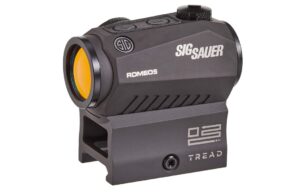
Few red dots have disrupted the budget optics market quite like the SIG SAUER ROMEO5. It delivers a feature set that would have cost three times as much a decade ago. At its core is SIG’s MOTAC (Motion Activated Illumination) system, which wakes the sight the instant you move the rifle and powers it down after a period of inactivity. It’s a genuinely clever feature that essentially eliminates dead batteries from your list of concerns.
The 2 MOA dot is sharp and clear across its ten brightness settings, two of which are dedicated night-vision positions. The aluminum body is IPX-7 waterproof, fog-proof, and built to handle the recoil of an AR without shifting zero. It ships with a riser mount already installed, positioning it at the correct height for AR co-witnessing out of the box, a small detail that eliminates the guesswork for new owners.
For someone building a first AR-15, buying on a budget, or equipping a home-defense rifle without breaking the bank, the ROMEO5 makes the argument that you no longer have to spend a fortune to get a genuinely trustworthy optic on your rifle. This is the new benchmark for affordable red dots.
Pros
- Excellent value for money
- Auto-on/off motion-activated illumination
- Ships with riser mount
- IPX-7 waterproof and fog-proof
- 10 brightness settings including 2 NV modes
Cons
- Not duty-grade durability
- Glass quality below premium optics
- Controls feel basic
6) Holosun 510C
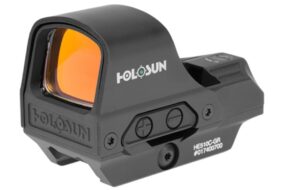
Holosun has earned its place in the optics conversation by building features into the 510C that would be audacious on a sight costing twice the price. The open emitter design gives you a massive, unobstructed field of view that rivals a holographic sight, and that’s not an accident. The generous window makes target acquisition on an AR-15 instinctively fast, particularly in dynamic shooting scenarios. What truly sets the 510C apart is its Multi-Reticle System (MRS), which lets you toggle between a 2 MOA dot, a 65 MOA circle, or a combination of both with a simple button press.
Then there’s the power system, which is genuinely innovative: the Shake Awake motion-sensing technology is paired with a solar failsafe panel on top of the housing. In bright conditions, the solar panel extends battery life dramatically, the CR2032 battery is rated for 50,000 hours on its own, but the solar assist can keep the sight running indefinitely in natural light. The 510C is also night-vision compatible across multiple settings. The titanium-alloy construction is rated to IP67 standards.
Pros
- Multi-Reticle System
- Solar failsafe panel extends battery life
- Shake Awake conserves battery during storage
- Open emitter gives a holographic-wide field of view
- IP67-rated titanium-alloy construction
Cons
- Open emitter exposed to debris without a lens cover
- Larger footprint than tube-style red dots
- Solar panel adds slight top-heaviness
Reflex Sight vs Holographic Sight
Reflex sights and holographic sights both provide fast target acquisition and allow shooters to keep both eyes open, but they use different technologies. A reflex sight uses an LED to project a dot onto a coated lens, making it lightweight, efficient, and capable of exceptionally long battery life.
Holographic sights, on the other hand, use a laser to project a holographic reticle onto the viewing window. This often results in a larger viewing area and a reticle that many shooters find faster and more precise, especially when paired with a magnifier. Holographic sights also tend to perform better if the viewing window is partially obstructed or damaged. However, they are generally heavier, more expensive, and consume batteries much faster than reflex sights.
Factors to Consider When Buying a Red Dot Sight
Dot Size
Red dot sights are commonly available with dot sizes measured in MOA (Minute of Angle). Smaller dots, such as 2 MOA, allow for more precise aiming at longer distances, while larger dots are often easier to pick up quickly at close range. Many shooters find that a 2 MOA or 3 MOA dot offers a good balance between speed and precision, making it suitable for a wide range of shooting applications.
While many red dots feature a simple dot reticle, some models offer additional options such as circle-dot configurations or selectable reticles. Multiple reticle choices can improve versatility and allow shooters to tailor the sight picture to different shooting scenarios.
Durability
A red dot sight should be able to withstand recoil, rough handling, and exposure to the elements. Optics built from high-quality aluminum typically offer better durability than cheaper alternatives. If the sight will be mounted on a hard-recoiling firearm or used in demanding outdoor conditions, look for a model with a reputation for ruggedness and reliable zero retention. A durable optic can save you money and frustration in the long run.
Battery Life
Battery life is one of the most important factors in a red dot sight. Some premium models can remain continuously powered for several years, while others may require more frequent battery changes. Long battery life is especially valuable for defensive firearms because the optic can remain ready at all times. Features such as motion activation or automatic shutoff can further extend battery performance and reduce maintenance.
Window Size
The size of the viewing window affects how quickly you can acquire targets. Larger windows provide a more open sight picture and can make rapid target transitions easier, especially during competitive or defensive shooting. Smaller windows often help reduce overall weight and bulk. Choosing the right window size depends on whether you prioritize speed, compactness, or a combination of both.
Optical Clarity
A quality red dot should provide a clear sight picture with minimal distortion. Better optics typically feature high-quality glass and advanced lens coatings that improve light transmission and reduce glare. Clear glass helps shooters identify targets more easily and can improve shooting confidence in various lighting conditions. Optical clarity becomes even more important when using a magnifier behind the red dot.
Brightness Settings
A red dot should offer enough brightness settings to perform well in different environments. The reticle must be visible in bright sunlight without appearing washed out, while lower settings should remain comfortable in dim conditions. Some optics also include night vision-compatible settings for specialized applications. A wide brightness range increases the sight’s versatility and usability.
Weight and Size
The size and weight of a red dot can significantly affect firearm handling. Compact optics help keep rifles and carbines lightweight and maneuverable, which is especially beneficial during extended shooting sessions. Larger optics may offer bigger viewing windows or additional features but can add noticeable weight. Consider how the sight will affect the balance and feel of your firearm before making a purchase.
Mounting System
A reliable mounting system is essential for maintaining zero and ensuring consistent performance. Some red dots include high-quality mounts, while others require a separate purchase. It is important to verify that the mount is compatible with your firearm and provides the proper height for a comfortable sight picture. A secure mount helps maximize the optic’s effectiveness and long-term reliability.
Compatibility with Magnifiers
Many shooters pair red dots with magnifiers to extend their effective range. If you plan to use a magnifier, ensure the red dot is designed to work well with one. A compatible setup allows you to quickly switch between close-range speed and increased magnification for longer shots, making the firearm more versatile.
FAQs
How far can you shoot accurately with a red dot sight?
A quality red dot can be effective from close range out to several hundred yards, depending on the shooter’s skill and the firearm being used. Most shooters find red dots particularly effective within 200 yards, although accurate hits at greater distances are certainly possible.
What is the difference between an open and an enclosed red dot?
An open red dot has an exposed emitter and generally offers a larger viewing area with less weight. An enclosed red dot seals the emitter inside a housing, providing better protection against dirt, rain, and debris.
Related
- Best red dot for rifles
- Red dot sight for astigmatism
- Cheap red dot under $200
- Best red dot magnifiers