
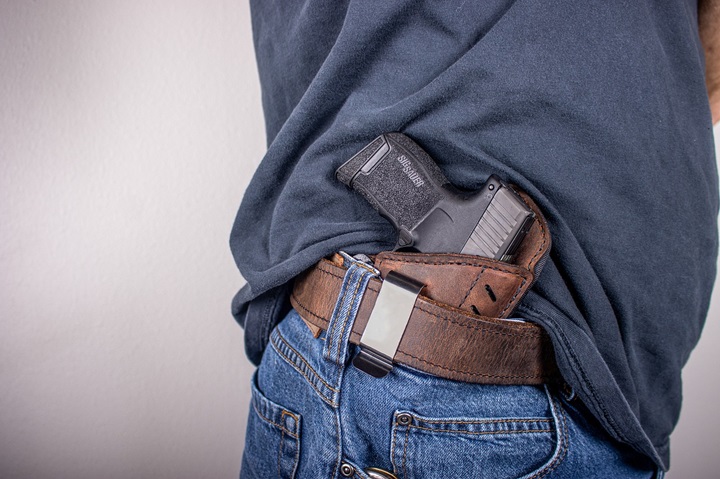
Imagine you’re getting dressed for the day. Your shirt fits, your pants sit just right, and then there’s that tiny, stubborn problem: where does the gun go? For larger-bodied guys, whether you call yourself big, thick, husky, or fat, the universal holster prescriptions rarely line up with reality.
The body is not a one-size cylinder: rolls, stomach shape, posture, and how you sit all change how a holster behaves. A poorly chosen holster irritates skin, prints badly, chews up clothing, or, worst of all, makes you avoid carrying at all.
This guide is practical and cuts through marketing fluff and focuses on what matters for larger bodies: comfort, stable support, concealment that actually works, and safe access.
Below are detailed reviews of holster types and proven carry solutions that respect real human shapes for the person who wants to carry comfortably and confidently without contorting into an “ideal” body type.
Here is a summary
- Neoprene Belly-Band Holster
- Pancake OWB Holster with Wide Belt Loops
- Hybrid IWB Holster
- Shoulder Holster with Broad Cross-Body Straps
- Concealed-Carry Fanny Pack / Hip Pack
- Drop-Leg / Thigh Holster
- Appendix-Style IWB
- Custom Holster & Tailored Belt Setup
Gun Holster for Fat Guys -Top Picks
1) Neoprene Belly-Band Holster
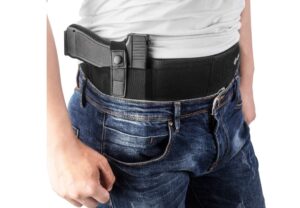
A quality neoprene belly-band holster is often the first real solution for larger-bodied men who struggle with belt carry.
The band wraps around the torso and fastens with Velcro, allowing it to sit above, across, or below a belly roll, depending on comfort and concealment. The holster pouch, usually a molded Kydex or reinforced fabric sleeve, holds the firearm against your side or slightly forward, and many models include pockets for magazine(s), phone, and ID.
The big win is adjustability: you can tighten enough to secure the pistol without needing a rigid belt, and the wide contact area spreads pressure so the gun doesn’t dig into skin when you sit.
Important features to watch for include breathable neoprene or mesh panels to reduce sweat, multiple carry positions for left/right or appendix-style carry, reinforced stitching and retention straps or adjustable tension screws on Kydex sleeves, and long Velcro fields to accommodate waistband variance.
For larger guys who sit a lot driving, in office chairs, or on the tractor, the belly-band keeps the gun stable and prevents the holster from migrating. It won’t be as discreet as a perfectly fitted IWB under a tucked shirt, but in practice, it often produces much better real-world concealment for changing body shapes.
Pros
- Highly adjustable and forgiving of waist/torso fluctuation.
- Distributes weight over a wide area; comfortable when seated.
- Often includes storage pockets for mags/phone.
Cons
- Can be warm and cause sweat if worn long periods.
- May require a cover garment (untucked shirt/Jacket) to fully conceal.
- Not as rigid or quick to draw from as a belt-mounted holster.
2) Pancake OWB Holster with Wide Belt Loops
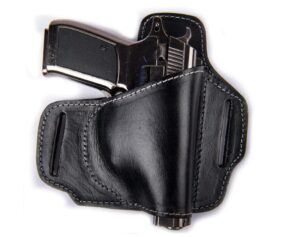
A classic pancake-style outside-the-waistband (OWB) holster with broad belt loops or a saddle-style mount becomes a surprisingly elegant option for larger guys. Instead of forcing the pistol into the cramped inside-the-waistband space, an OWB pancake holster rides on a sturdy leather or Kydex backing that hugs the hip.
The wide belt loops distribute the pistol’s weight across several inches of belt, which is essential if you’re using a heavy gun or a larger-size belt. Because the holster sits outside the waistband, it doesn’t get lost under stomach folds and is easier to reholster, an important safety plus when clothing bunches.
Look for a holster with an adjustable cant and ride height, a sweat guard to protect the firearm from skin oil and to protect skin from sharp edges, and a thumb-break or retention device that balances safety with quick access. Paired with a strong, 1.5–2.25-inch-thick leather or reinforced nylon belt, this configuration provides solid mechanical support and excellent draw consistency. You’ll conceal best with a jacket, untucked shirt, or a long top; for many larger-bodied men, this is the easiest route to combine comfort and quick access without wrestling the gun into a tight IWB position.
Pros
- Excellent support and weight distribution for larger pistols.
- Faster reholster and consistent draw path.
- Less pressure on the abdomen; comfortable for seated carry.
Cons
- Requires over-garment or long shirts for concealment.
- OWB can print without proper garment coverage.
- Some pants with low-rise waistlines make placement tricky.
3) Hybrid IWB Holster with Wide Backing
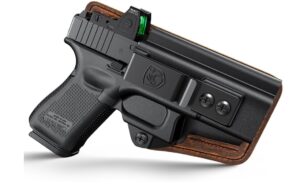
A hybrid inside-the-waistband (IWB) holster that pairs a molded Kydex shell with a wide leather or neoprene backing is one of the best compromises for larger bodies who want a true concealed IWB carry.
The wide backing prevents the Kydex from digging into the skin and spreads contact over a larger area, reducing pressure on the abdomen and making sitting more comfortably. The leather or neoprene also helps prevent printing because it creates a smoother transition between gun and body profile.
Key features to prioritize are: long, sturdy clips that can attach to a wider waistband (and preferably have multiple mounting positions), a full-length sweat guard, adjustable retention screws on the Kydex, and an outward-facing muzzle angle that tucks under clothing. For larger guys, consider holsters that allow the mouth of the holster to sit slightly above the beltline, this reduces gas pressure against the belly when seated and improves concealment.
Hybrid IWBs give a near-cloak of concealment with the support of a comfortable contact surface; they’re an excellent middle ground if you prefer to carry on-belt but need more forgiveness from your body shape.
Pros
- Combines secure Kydex retention with a comfortable backing.
- Good concealment when paired with the right garment.
- Flexible mounting positions and adjustable cant.
Cons
- Can be tricky to reholster if shirt is too tight.
- Requires a strong, supportive belt to prevent sag.
- Some backing materials can trap sweat and need cleaning.
4) Shoulder Holster with Broad Cross-Body Straps
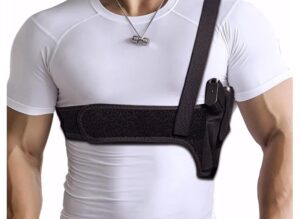
For guys who have a pronounced belly and find waist carry uncomfortable or impractical, a properly fitted shoulder holster is a brilliant alternative. A harness with wide, padded straps transfers the pistol’s weight from the waist to the shoulders and upper torso, which is often more comfortable for extended wear.
Shoulder rigs work best with a jacket or open-front garment to hide the outline and allow a natural underarm draw. They’re also friendly to seated carry: the gun remains accessible even while you’re driving or sitting in tight spaces.
Modern shoulder holsters feature quick-adjust straps, removable mag pouches, and ambidextrous setups so you can cross-draw or strong-side draw.
Look for harnesses with non-slip padding, reinforced stitching, and holster shells that secure the pistol snugly but allow a smooth draw. Keep in mind: shoulder holsters require practice to avoid printing through jackets and to master a safe, smooth draw stroke. But for larger guys who need distribution and comfort without sacrificing serviceable accessibility, a shoulder rig can be liberating.
Pros
- Redistributes weight from abdomen to shoulders.
- Comfortable while seated; easy access in cars.
- Discreet with the right outer garment.
Cons
- Requires jacket or an outer layer for concealment.
- Can feel warm across the upper back and underarms.
- Needs a precise fit to avoid shifting or printing.
5) Concealed-Carry Fanny Pack / Hip Pack Holster
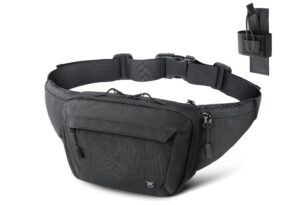
Fanny packs (hip packs) designed for concealed carry have come a long way. For larger individuals who can’t or won’t wear a stiff belt, a purpose-built CCW hip pack provides a simple and effective alternative.
These packs feature an inner holster compartment that secures the firearm, along with exterior pockets for magazines, a wallet, and a phone. Because they sit across the hips or front of the waist, they don’t fight stomach contour the way a belt-mounted holster does, and they’re fast to put on and remove.
Look for packs with a dedicated holster sleeve (often compatible with Kydex or soft holsters), an adjustable strap system that won’t ride up, and sturdy zippers or security flaps. Many are ambidextrous and include interior compression panels to keep the gun snug.
Fanny packs are ideal for casual concealed carry, travel, or when you need both storage and quick access without complex rigging. The trade-off is that, unless carefully selected, they can be bulky and may look like typical “tourist” fanny packs, but functionally they’re often the most comfortable carry method for larger-bodied carriers.
Pros
- No stiff belt required; comfortable around large waists.
- Extra storage and quick access.
- Easy to put on and remove.
Cons
- Bulkier and sometimes harder to disguise as regular clothing.
- May shift when bending unless properly tightened.
- Zipper reliability and holster retention vary by model.
6) Drop-Leg / Thigh Holster with Stabilizer Strap
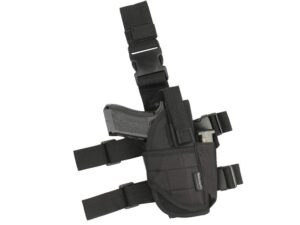
Drop-leg or thigh holsters mount to the belt and strap around the thigh, positioning the gun a little lower and farther from the belly. This placement is helpful for taller or larger guys who need their pistols lower to avoid cover garment interference, or for workers who sit frequently and require easy access while seated.
The stabilizing strap keeps the holster from flapping and ensures a repeatable draw stroke. Essential features include a strong belt loop or platform, an adjustable thigh strap with non-slip material, and robust retention (thumb strap, locking hood, or Kydex retention).
Because drop-leg holsters extend below the waistband, they are less likely to print through shirts or be hampered by stomach folds. They’re commonly used by first responders, off-duty professionals, and folks who want a stable, accessible carry point that stays out of the way of the abdomen.
They’re not ideal for discreet concealed carry in business casual settings, but they shine for practical concealment under work clothes or outerwear.
Pros
- Keeps gun away from belly and waist folds.
- Stable and repeatable draw stroke.
- Comfortable while seated and popular in tactical contexts.
Cons
- Harder to conceal in light clothing; best with outer garments.
- Strap placement must be secure to avoid slippage.
- Can feel awkward for some body shapes without custom adjustment.
7) Appendix-Style IWB with Long Clips and Wing System
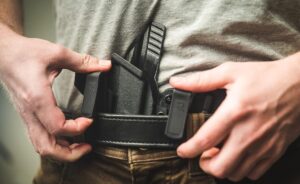
Appendix carry often gets a strong reaction, but with the right holster design, it can work for some larger guys, particularly those with a lower belly profile or a carry posture that allows the firearm to tuck in front with minimal pressure. Look for holsters built specifically for larger torsos: long, robust clips that can reach over the soft belly and attach to the belt or waistband, a pressure-diffusing wing that pulls the grip closer to the body, and a tapered muzzle to ease sit-down comfort.
These holsters often include adjustable ride height and can’t to tailor how the grip sits against the shirt line.
Appendix carry for larger guys requires testing and practice: the comfort sweet spot is highly individual. It offers very fast access and excellent concealment with tight clothing when it’s comfortable.
If you have concerns about safety or find the appendix painful, fall back to hybrid IWB or OWB solutions. But don’t dismiss appendix outright the right holster design and careful fitting can make it a real option.
Pros
- Excellent concealment under the shirt.
- Fast access and natural draw.
- Works with short shirts and tighter clothing if set up properly.
Cons
- Not comfortable for everyone.
- Requires strong clips and careful positioning to avoid discomfort while sitting.
8) Custom Holster & Tailored Belt Setup
When off-the-shelf options fall short, a custom holster and supportive belt setup is the premium fix. Custom holster makers can build a hybrid or OWB holster to exact dimensions: wider backings, custom-molded Kydex shells positioned for your unique torso, extended clips or thong-style attachments, and reinforced leather belts with 2-inch+ widths that won’t sag.
A custom harness can also redistribute weight perfectly and include features like integrated mag carriers or quick-detach mounting.
Custom solutions are more expensive but solve persistent problems: they can eliminate hot spots, prevent printing through common garments, and align retention and draw geometry to your body and daily routines.
If you carry daily and comfort is non-negotiable, investing in a custom rig and a heavy-duty support belt pays dividends in confidence and convenience.
Pros
- Tailored to your body and carry habits for maximum comfort.
- Built to handle heavier pistols without sag.
- Solves niche fit problems that off-the-shelf holsters can’t.
Cons
- Higher cost and longer lead time.
- Requires accurate measurements and possibly fitting adjustments.
- Less flexibility if you change pistols often.
Factors to consider when buying a Gun Holster as a Fat Guy
Carry position and daily posture
How you sit, drive, and move affects holster choice. Someone who sits at a desk all day will value low-profile, seated-friendly carry (belly-band, shoulder, or drop-leg), while a person who moves and bends frequently may prefer OWB or a well-backed IWB to avoid compression. Evaluate your typical posture and choose a carry location that won’t put constant pressure on soft tissues or cause the holster to shift.
Belt and support system
A strong belt is the backbone of comfortable carry for larger guys. Thin belts sag and allow the gun to droop into soft areas, increasing printing and discomfort.
Look for reinforced leather or lined nylon belts rated 1.5–2.25 inches wide with firm rigidity. Consider a belt with a removable inner stiffener or a dedicated gun belt to distribute weight and preserve the holster’s geometry.
Holster material & construction
Materials matter: Kydex holds retention and allows fast reholstering; leather molds to the body but can flex; hybrid leather/Kydex gives a mix of comfort and rigidity. For larger bodies, a wider backing made of leather, neoprene, or leather-reinforced fabric prevents edge pressure. Inspect stitching, rivets, and clip hardware — these must be robust to handle weight and repeated use.
Retention level & safety
Retention should match your lifestyle. Passive retention (friction) is fine for many, while active retention (thumb break, hood) adds security during physical tasks. The holster must shield the trigger and prevent accidental access. For larger or active folks, increased retention prevents snagging when the holster moves under clothing or while bending.
Adjustability
Adjustable cant and ride height let you position the firearm to avoid soft spots and optimize draw angle. Longer clips or dual-clip systems help anchor the holster over the belt even if the waistband is deep under a belly fold. A wing or anti-print device can pull the grip in toward the torso, improving concealment without increasing pressure.
Comfort & padding
Padding reduces chafing and pressure points. Wide backings and soft materials are kinder to soft tissue. Breathable fabrics reduce sweat and skin irritation. For extended carry, test for hot-spot formation and ensure the holster doesn’t pinch during normal movement. Comfort encourages consistent carry, which is the whole point.
Clothing and layering
Concealment is clothing-dependent. A jacket or long untucked shirt hides OWB nicely; a looser shirt helps hybrid IWB; a belly-band works under looser layers. Think about your wardrobe and how the holster sits under the garments you actually wear. If you don’t wear jackets, prioritize holster types that are friendly to your shirts and body profile.
Concealment vs accessibility trade-offs
The tightest concealment often sacrifices speed and comfort; the most accessible setups can be harder to hide. Larger bodies often benefit from choosing a comfortable, slightly more visible setup that conceals well with practical garments rather than trying to force ultra-deep concealment that’s uncomfortable and unreliable.
Try-before-you-buy & return policies
Because body shape is personal, try holsters where possible. Many manufacturers offer trial periods or satisfaction guarantees; use them. Check return policies for custom holsters and be ready to fine-tune attachments. Buying blind is a gamble, prioritize vendors with flexible returns and clear adjustment instructions.
Maintenance, hygiene & cleaning
Holsters trap sweat and oils; breathable materials and removable liners simplify cleaning. Neoprene and leather need different care (conditioning for leather; washing and drying for neoprene). Durable hardware resists rust. Regular cleaning prevents odor, skin issues, and premature material breakdown.
FAQs
What holster is best for a large belly?
There’s no single best holster; choices depend on activity and clothing. Belly-band holsters and fanny-pack holsters often beat belt-only solutions because they don’t depend on tight waistlines. A wide-backed hybrid IWB or a sturdy OWB pancake holster on a reinforced belt can also work well. Try options to find the right balance of comfort and concealment.
Can I carry an appendix if I’m overweight?
Appendix carry can work for some larger-bodied men but is highly sensitive to belly shape and seating posture. You’ll need long, secure clips, a holster with a wing or pressure diffuser, and careful fitting. If you experience discomfort, consider hybrid IWB or OWB options. Always practice draw and reholstering safely before relying on appendix carry.
Is a shoulder holster a good idea for everyday carry?
Yes, shoulder rigs redistribute weight and are comfortable for many large-bodied carriers, especially if you sit a lot or have problems with waist carry. They typically need a jacket or outer garment to conceal effectively but offer fast access. Proper fit is crucial to avoid printing and shifting.
How do I prevent printing and show-through?
Pick holsters with wide backings that smooth the pistol outline, use a wing or anti-print device, and match holster placement to garments that provide cover (longer shirts, jackets). Adjust ride height and can’t to tuck the grip under the fabric. Sometimes a small change in shirt length or a light jacket makes the biggest difference.
What belt should I use for heavy pistols?
Use a reinforced gun belt 1.5–2.25 inches wide with a stiff inner core (leather with a stiffener or purpose-built nylon). Avoid fashion belts. A good belt keeps the holster stable, maintains draw geometry, and prevents sagging into soft tissue — essential for comfort and concealment.
Are fanny pack holsters safe and effective?
Fanny pack holsters are safe when used with a dedicated holster compartment and proper retention. They’re effective for larger people because they bypass the waistline problem and provide storage. Choose packs with a discreet look, reliable zippers, and an inner holster pocket to secure the pistol.
How should I practice drawing from an unconventional holster?
Dry-fire practice, slow-motion draws, and safe drills build muscle memory. Start slowly at home, ensuring muzzle awareness, then progress to dressed and seated drills. Consistent practice helps you overcome unusual draw angles and ensures safe reholstering under real conditions.
Do I need a custom holster?
A: Not always, but custom holsters justify their cost when off-the-shelf options cause persistent discomfort or printing. A custom holster and heavy-duty belt tailored to your body and pistol deliver the best comfort, retention, and concealment if you carry daily.
Final thoughts
Carrying while being larger-bodied is about adaptation, not punishment. The right holster fits your routine, clothes, and how your body actually sits and moves. Prioritize support first (good belt or harness), then concealment that works with the clothes you wear, and never skimp on retention and trigger safety.
Try solutions like belly-band or fanny-pack options for immediate comfort, and consider a hybrid IWB or pancake OWB once you find what works. If budget allows, a custom setup repays investment with daily comfort.
Related