Long-range shooting rewards patience, math, and good gear, and among those three, a great optic pays dividends faster than any extra practice round.
You don’t have to spend flagship money to get capable long-range performance. In recent years, the “$1,000 or under” category has exploded.
Manufacturers now pack first-focal-plane reticles, long-travel turrets, ED glass, and true zero-stop mechanics into optics that used to cost far more.
This article cuts through marketing spin to show practical, field-tested long-range scopes under $1,000, real options you can mount, dial, and trust when targets move past the 500–800-yard mark and beyond, when conditions allow.
Below you’ll find the reviews, but first, a quick summary
- Vortex Viper Gen II 5–25×50
- Bushnell Match Pro ED 5–30×56
- Riton 5 CONQUER 5–25×56
- Athlon Argos BTR Gen II 6–24×50
- Primary Arms SLx 3–18×50
- SIG SAUER WHISKEY6 3-18X44
Long Range Scope Under $1000- Top Picks
1. Vortex Viper Gen II 5–25×50 FFP
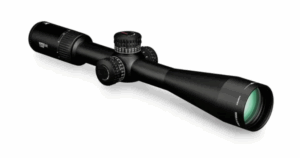
The Viper PST Gen II 5–25×50 is a compelling mix of modern tactical features tuned for precision shooters who want a scope that’s at home on an action rifle or a bolt gun. The 5–25× zoom covers close-to-mid work and still pushes far enough for precision dialing at long range; the 50mm objective keeps the package reasonably sleek while still gathering good light.
Vortex fitted this model with a first-focal-plane (FFP) reticle, which means your subtensions scale with magnification, ideal when you want holdovers or ranging marks to remain accurate at any power.
Reviewers consistently praise its tracking and the overall balance of glass quality versus price; compared to higher-tier optics, it’s often singled out as delivering similar capability for substantially less cash.
The exposed, tactile turrets are built for repeatability and quick dialing; many shooters appreciate the positive click feel and the ability to set a zero-stop that prevents overshooting your base zero.
For long-range use, it’s versatile with plenty of magnification, reliable turrets, and a reticle layout that plays well with range cards or ballistic calculators. If you want a “do-it-all” precision optic that won’t immediately push you into the $1,200–$2,000 bracket, the Viper PST II is a balanced, dependable choice.
Pros
- Excellent feature set for price
- Strong turret feel and good tracking.
- Good warranty and dealer support.
Cons
- Near the top of the $1,000 limit for some variations.
- Slightly less edge-to-edge clarity than flagships.
2. Bushnell Match Pro ED 5–30×56
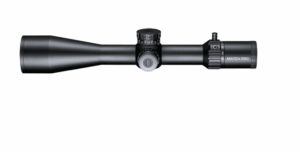
Bushnell’s Match Pro ED 5–30×56 punches above its weight by offering a 30× maximum, ED extra-low dispersion (ED) glass, and competition-oriented features at a sub-$1,000 price point.
The extended magnification range (5–30×) and a 56mm objective make it a clear contender for PRS-style competition and long-range target work.
you can get tight enough groups at distance while still having usable low-power settings for target acquisition and variable lighting. The Match Pro line is built around ED glass to reduce chromatic aberration and improve contrast, useful when you’re resolving fine target detail at long yards.
Reviews and field tests show that the Match Pro holds zero and gives crisp mil or MOA subtensions for ranging and holdovers, with the kind of repeatable turret action precision shooters need in competitions.
If you want competition-capable features without the competition-tier price, this is one of the best bargains in long-range optics today. Keep in mind the larger objective means a bigger tube and slightly more weight, but for stationary or bipod work, that trade is worth it for many shooters.
Pros
- Class-leading 30× top-end magnification at this price.
- ED glass for improved clarity/contrast.
- Competition-focused features.
- Solid adjustment range.
Cons
- Bigger, heavier profile (56mm objective).
3. Riton 5 CONQUER 5–25×56
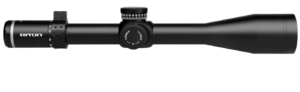
Riton’s 5 CONQUER 5–25×56 brings a 5x zoom, a large 56mm objective, and a feature set (FFP reticle, zero-stop turrets, throw lever options) that targets precision shooters who want modern conveniences without flagship pricing.
The CONQUER line emphasizes a wide magnification range with a robust 34mm tube and turrets designed for repeatable dialing; Riton often markets this series directly to serious shooters who need maneuverable but full-featured optics.
Reviews point out that the glass clarity and color rendition compete well with other manufacturers’ mid-tier offerings, and the integrated zero-stop makes it easy to return to your base zero after dialing long shots.
Where this scope shines is in giving you the mechanical features, big elevation travel, reliable turret feel, FFP reticle subtensions, many shooters want for high-angle or long-range work, all at a street price comfortably under $1,000.
Some users mention preferences for slightly different reticle styles or illumination strength, but overall, the 5 CONQUER is a solid long-range-oriented package.
Pros
- Robust feature set for the price.
- Good optical performance for long-range work.
- Designed with precision shooters in mind.
Cons
- Illumination and ergonomics vary by reticle choice.
- Not as established a brand.
4. Athlon Argos BTR Gen II 6–24×50
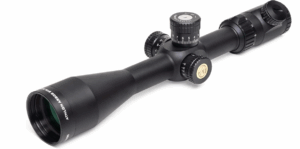
Athlon’s Argos BTR Gen II is a perennial recommendation for shooters who want functional long-range features without high cost.
The Gen II variants frequently bring upgrades such as a true zero-stop turret and improved coatings, and the 6–24× magnification band gives a lot of practical reach for hitting targets past 500 yards.
Optically, the Argos line has surprised many users with its clarity relative to price. The glass is good enough for precision hunting and many target applications, and the reticle choices and turret ergonomics are tailored toward practical dialing and holdovers.
Because the Argos is priced in the hundreds rather than near the $1,000 ceiling, many shooters use it as a workhorse on training rifles, tacticool builds, or budget-priority long-range rifles.
However, expect less light-gathering or marginally softer edges compared to premium ED-glass scopes, but for the money, the value proposition is strong, especially if you need a scope that can take hard use without costing a fortune to replace.
Pros
- Outstanding value
- Decent turret travel.
- Durable enough for practical field use.
Cons
- Some finish/ergonomic details show its budget positioning.
5. Primary Arms SLx 3–18×50 FFP
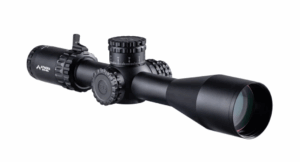
Primary Arms has carved a niche offering feature-forward optics with approachable pricing; their SLx line often includes first focal plane reticles and modern turret packages.
The 3–18×50 FFP model is a versatile scope with moderate-to-high magnification for mid/long ranges. The objective diameter is decent for light gathering, and reticles are designed to work smoothly with ballistic solutions like ACSS or mil-based hash marks.
Where Primary Arms shines is in delivering user-friendly reticle designs that integrate ranging hold points with a low price point, great for shooters who want to learn dialing without spending flagship money.
The trade-offs are in ultimate glass performance and possibly max elevation travel compared to the most expensive scopes. These Primary Arms FFP models are pragmatic picks that bridge the gap between entry-level and true high-end. Many owners praise the repeatability and community support.
Pros
- Great reticles for practical ranging and rapid engagement.
- Excellent value
- Great community ballistics support.
- Lightweight compared to 50–56mm scopes.
Cons
- Not the absolute top glass at extreme ranges.
- Turret travel is not as long
6. SIG SAUER WHISKEY6 3-18X44mm
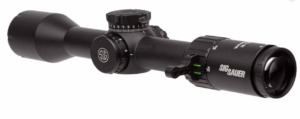
The SIG SAUER WHISKEY6 3-18X44mm delivers excellent durability while maintaining a sleek profile. The magnification range of 3-18x gives users the flexibility to engage targets both at close range and distances beyond 600 yards, making it highly versatile for various shooting environments.
One standout feature is the HDX optics system, which combines high-definition and extra-low dispersion glass for superior light transmission, claimed by the manufacturer to be at 98.6%, and edge-to-edge clarity. This more than compensates for the rather small (44mm) objective lens.
The brightness makes target acquisition easier even in low-light conditions such as dawn or dusk. Moreover, an illuminated reticle provides sharp aiming points in challenging lighting situations, and multiple brightness settings ensure adaptability to different backgrounds and environments.
The scope is waterproof, fog-proof, and shockproof, giving shooters peace of mind in rugged outdoor conditions. A side parallax adjustment adds to the precision, ensuring accurate shots at extended distances.
Pros
- Wide magnification range (3-18x)
- Excellent clarity
- Illuminated reticle with multiple brightness levels
- Rugged construction
- Smooth side parallax adjustment
- Lightweight and field-ready
Cons
- Slightly smaller objective lens (44mm)
- Limited reticle choices for highly specialized shooters
What to look for (Buying guide)
Magnification range
Magnification determines how large a distant target appears and how finely you can hold or aim. For long-range precision, most experts recommend peak magnification of 18× or higher if you plan to engage beyond 600–800 yards.
Competition optics often go to 25–30× for fine resolution, which is ideal for a static bench. Lower-powered ranges (3–12×, 4–14×) give faster target acquisition and are better for hunting or mobile roles. Choose a range that matches the type of shooting
Objective lens
Bigger objective lenses (50–56mm) gather more light, improving image brightness at long distances and low-light scenarios.
However, they add weight and require taller mounts. If most of your shooting is in daylight and you need a light rifle, a 44–50mm objective might be a better compromise. Also look for ED glass and modern coatings, which improve contrast and reduce color fringing at long ranges.
First Focal Plane (FFP) vs Second Focal Plane (SFP)
FFP reticles scale with magnification, so subtension markings (mils/MOA) stay accurate at any zoom, a major benefit when ranging or using holdovers at varied magnifications.
SFP keeps the reticle the same size regardless of zoom and is often preferred for hunting or when you rely on the reticle at a specific magnification. For most precision long-range shooters, FFP is the better choice because it simplifies holdovers and ballistic calculations.
Reticle type
Choose a reticle that matches your ballistic method. Mil-based grids, MOA stadia, or specialized reticles like ACSS. Busy reticles give lots of subtension data for rapid holds and wind calls, while simple crosshairs keep the view uncluttered.
Illuminated reticles help in low light but ensure the illumination is intuitive and doesn’t obscure fine aiming points.
Turrets
Turret precision (click value: 0.1 MIL or 0.25 MOA common) matters because long-range corrections are made in small increments. Repeatability, the ability to dial and return to zero reliably, is the single biggest practical turret trait. Zero-stop is a mechanical convenience that prevents you from accidentally dialing past zero and lets you snap back to your base zero instantly.
Glass quality & coatings
ED (extra-low dispersion) or HD glass yields sharper resolution and better color fidelity at long range. Multi-coatings or proprietary anti-reflective coatings boost light transmission and reduce glare.
High-quality glass is often the most noticeable performance differentiator when resolving small targets at distance.
Eye relief & field of view
Longer eye relief is safer and more forgiving for rapid transitions. The field of view (FOV) at low magnification influences how fast you can find targets and track movement. Choose a scope that balances a comfortable FOV with adequate eye relief for your shooting platform.
Weight
Heavier scopes often mean better glass or larger objectives, but they also raise the center of gravity and may need stronger mounts. Match scope weight to your rifle’s intended role. Make sure rings and mounts are rated for the tube diameter and that rail height supports the objective diameter.
Warranty and manufacturer support
A reliable warranty and established customer service can save time and money if a scope needs repair.
Some brands offer unconditional lifetime VIP-type warranties; others are limited by region. When buying a scope under $1,000, account for warranty reputation as part of the value equation.
FAQs
1) Do I need a first focal plane reticle for long-range shooting?
An FFP reticle is highly recommended for long-range shooters who rely on reticle subtensions for ranging and holdovers across different magnifications. Because the reticle scales with zoom, a mil or MOA grid will be true at any power setting.
This removes math or memorization when moving between magnifications. For precision work, FFP simplifies ballistic holds and makes quick corrections more intuitive.
SFP still works if you only use the reticle at one magnification, but FFP is the safer choice for dynamic long-range use.
2) What magnification should I aim for if I want to shoot out to 1,000 yards?
For consistent hits at 1,000 yards under typical field conditions, a scope with top-end magnification around 20–30× is ideal, as it gives the resolution to identify and hold on to small target details.
However, good glass and a stable rest or shooting position are equally important. If your rifle, ammunition, and optics are all well-matched, a 20–25× optic can be sufficient; competition-level shooters often prefer 25–30× for the extra resolving power.
3) Are scopes under $1,000 accurate enough for serious long-range work?
Yes, many modern optics under $1,000 offer excellent repeatability, FFP reticles, long elevation travel, and quality coatings.
The key is to match the scope to your needs. A $700–$1,000 scope with ED glass and a true zero-stop can perform reliably for 800–1,000-yard work when paired with a capable rifle and ammo.
Expect marginal differences in ultimate edge-to-edge clarity or max usable magnification versus flagship optics, but not necessarily in functional accuracy for most shooters.
4) How important is turret repeatability and testing?
Turret repeatability is critical. If turrets don’t return exactly to zero after dialing, your ballistic solutions and holdovers break down. Always test turrets at the range: dial full elevation travel and return to zero multiple times, then confirm the point of impact.
Good scopes at this price point usually have reliable, tactile clicks, but testing ensures you catch anomalies before they matter on integrated systems or in matches.
5) Should I choose a 30mm tube or 34mm tube for long-range shooting?
A 34mm tube typically offers more internal adjustment, which is useful for extremely long-range trajectories without relying on canted rails or specialized mounts.
30mm tubes are lighter and often sufficient for moderate long-range use. If you anticipate dialing large amounts for heavy bullets or extreme distances, 34mm gives extra headroom; otherwise, 30mm balances weight and functionality and has a wider ring accessory ecosystem.
6) How do coatings and ED glass affect shooting in real conditions?
ED glass reduces chromatic aberration and improves sharpness and contrast at long distances. It makes target edges crisper, especially at high magnifications.
Coatings improve light transmission and reduce reflections, increasing usable brightness in dawn/dusk shots. While they don’t change ballistics, they directly affect your ability to identify and precisely place shots at long range, especially in marginal lighting.
Final Thoughts
Choosing the best rifle scope for shooting at long-range distances is crucial if you want to achieve repeated success. The best scope doesn’t really have to break the bank, and this article analyzes the best alternatives that you can have for under $1000. These scopes do not just come close to the performance of pricier alternatives; they give a shooter value when doing so.
See Also: Best Long Range Scopes On a Budget