If you own an AR or any carbine, adding a low-power variable optic changes everything. These scopes act like a red dot at 1x for super-fast aiming up close. Then you twist the dial and get real magnification for clear shots hundreds of yards away. The great news is you do not have to spend a fortune anymore. Plenty of solid options now offer bright glass, tough builds, smart reticles, and handy extras at prices that feel fair.
This article looks at the best ones that give the most bang for your buck. Simple, honest picks to help you choose wisely.
Here is a quick recap;
- Vortex Viper PST Gen II 1-6x
- Atibal XP6 Mirage 1-6x24mm
- SIG SAUER Tango-MSR LPVO 1-6x24mm
- Vortex Optics Strike Eagle 1-8×24
- Arken Optics EP8 1-8×28 LPVO
- Primary Arms SLX 1-6x24mm
- Swampfox Arrowhead 1-10×24 SFP
Best LPVO Scopes for The Money – Reviews
1) Vortex Viper PST Gen II 1-6x
The Vortex Viper PST Gen II 1-6x is widely considered the gold standard for anyone who wants high-end performance without the high-end price tag. It occupies a unique space in the optics world, often described as offering roughly 90% of the capability found in top-tier professional glass for less than half the cost. This makes it a formidable choice for everything from competitive 3-gun matches to serious tactical applications.
What immediately stands out when looking through this glass is the optical clarity. Vortex uses extra-low dispersion lens elements that provide a crisp, edge-to-edge image that holds up remarkably well, even when the magnification is cranked to the maximum. At 1x, the view is exceptionally natural, allowing for lightning-fast, both-eyes-open target acquisition that rivals a dedicated red dot. This transition to 6x is seamless, providing enough reach to confidently engage targets out to several hundred yards.
The reticle illumination is another area where this scope punches far above its weight. While many mid-range optics struggle with being washed out in high noon sunlight, the center point on the Viper PST remains daylight bright. It features ten intensity levels with a convenient off position between each setting, allowing for instant activation to a preferred brightness. The VMR-2 reticle itself is clean and functional, offering precise holdover points for elevation and windage without cluttering the field of view.
The scope is built from a single piece of aircraft-grade aluminum, the 30mm tube is argon-purged and O-ring sealed to be completely waterproof and fog-proof. It is a robust, over-engineered piece of equipment designed to survive the bumps and recoil of hard use. When you combine this build quality with a forgiving eye box and a generous 3.8 inches of eye relief, the result is a scope that is not just a bargain, but a legitimate professional tool.
Pros
- Exceptional Glass Quality
- Daylight Bright Illumination
- Forgiving Eye Box
- Rapid zero return system and matching reticle/turret measurements (MOA or MRAD).
- Vortex VIP Warranty
Cons
- At 22.7 ounces, it is notably heavier than many of its competitors
2) Atibal XP6 Mirage 1-6x24mm
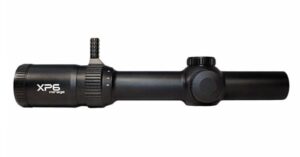
The Atibal XP6 Mirage 1-6x24mm is a compact scope that weighs just 18 ounces and measures about 10.5 inches long, making it easy to maneuver without adding bulk. Built from aircraft-grade aluminum, it withstands shock, water, and fog, and many users praise its ability to hold zero through hundreds of rounds and rough treatment.
Its Mirage reticle shines as a standout feature in the first focal plane configuration. It includes a precise 1 MOA center dot surrounded by a 32 MOA horseshoe for quick close-range acquisition, plus a lower ladder with clean 4 MOA hash marks starting below the center for ranging known-size targets or creating custom holdovers. This simple, uncluttered design avoids overly busy BDC lines, offering versatility across calibers. Red illumination with 11 settings helps in low light, and the etched black reticle remains usable even when illumination washes out in bright conditions.
Glass quality provides surprising clarity with fully multi-coated lenses achieving solid light transmission and minimal edge distortion, performing well for its class. The rapid view lever enables smooth, quick magnification changes, and generous eye relief keeps the sight picture forgiving on recoiling platforms.
Pros
- First focal plane reticle
- Clean, intuitive Mirage reticle
- Excellent clarity and light transmission
- Lightweight, durable construction
- Integrated rapid view lever
- Generous eye relief and wide field of view at 1x
- Lifetime warranty
Cons
- Some edge distortion and chromatic aberration at higher magnification
- Reticle lacks windage holds or more advanced ranging option
3) SIG SAUER Tango-MSR LPVO 1-6x24mm
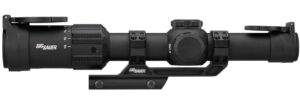
The SIG SAUER Tango-MSR LPVO 1-6x24mm proves itself as a reliable budget-friendly optic ideal for AR platforms. It comes with an illuminated MSR BDC6 reticle of second focal plane design. It features a clean horseshoe with a center dot for fast acquisition at 1x, plus a Christmas-tree style lower section with holdover marks calibrated for common 5.56/223 loads out to several hundred yards. Eleven brightness settings make the red illumination effective in low light, and the etched glass ensures the black reticle remains visible without power.
Glass quality delivers surprising brightness and clarity for the class, with low-dispersion lenses minimizing distortion and offering a wide field of view. The included Alpha cantilever mount, flip-up lens covers, and throw lever add tremendous ready-to-go convenience.
This scope shines as a value standout by bundling solid performance, essential accessories, and dependable tracking into a package often found under $300, delivering features and quality that outperform many competitors in the sub-$400 range, like certain Vortex or Primary Arms entry models.
Pros
- True 1x performance for red dot-like speed
- Clear, bright glass with good light transmission
- Illuminated BDC6 reticle with useful holdovers
- Durable build that reliably holds zero
- Smooth magnification ring and generous eye relief
- Exceptional value with bundled accessories
Cons
- Second focal plane may not appeal to everyone
- Turrets feel mushy with less tactile feedback
4) Vortex Optics Strike Eagle 1-8×24
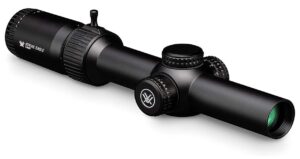
The Vortex Optics Strike Eagle 1-8×24 frequently tops the list for good reason. This scope is available in both second focal plane (with the illuminated AR-BDC3 reticle) and first focal plane (EBR-8) versions. It offers options without overwhelming complexity. Fully multi-coated glass provides respectable brightness and clarity, while the rugged aluminum body shrugs off recoil, drops, and weather, backed by Vortex’s legendary lifetime warranty.
The AR-BDC3 reticle in SFP models features a bold horseshoe surrounding an illuminated center dot for lightning-fast acquisition at 1x, with lower hash marks offering calibrated holdovers for popular 5.56 loads out to 600+ yards.
FFP variants use the EBR-8, scaling precisely across the range with wind dots and ranging features for more advanced use. Eleven illumination settings help in dim conditions, and the etched design ensures visibility even when unpowered. A threaded throw lever speeds power changes, and generous eye relief accommodates varied shooting positions.
Pros
- Bright, clear glass with good transmission for the class
- Practical illuminated reticle (AR-BDC3 or EBR-8) with effective holdovers
- Lightweight and tough construction
- Wide field of view and comfortable eye relief
- Outstanding value backed by lifetime warranty
Cons
- SFP models restrict precise holdovers to maximum magnification
- Heavier in FFP version than some rivals
5) Arken Optics EP8 1-8×28 LPVO
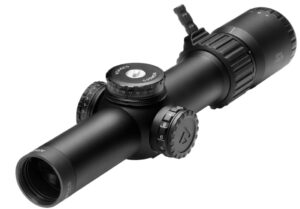
Arken Optics broke into the crowded LPVO market with the EP8 1-8×28, delivering a first focal plane optic that prioritizes speed, ranging, and affordability and for sure you get some good value. This compact scope weighs 21 ounces on a 34mm tube, offering a true 1x experience with a wide field of view for both-eyes-open shooting, while the integrated throw lever allows seamless transitions to 8x for mid-range precision.
Built from aircraft-grade aluminum, it proves rugged shockproof, waterproof, and fogproof—with users reporting consistent zero retention through heavy use and rough conditions. The standout KL Box (Known Length Box, often called “Kill Box”) reticle dominates discussions. This patent-pending FFP design features a large outer ring reminiscent of an EOTech holographic sight for rapid close-quarters acquisition, enclosing a fine center dot and lower BDC ladder with boxed holds that use known target dimensions to quickly estimate distance and holdover. Illumination aids low-light visibility while the etched reticle works unpowered.
Japanese glass provides impressive clarity and brightness for the class, with minimal distortion at lower powers and solid low-light performance. Eye relief stays generous, and the wide FOV at 1x feels forgiving.
Pros
- Innovative FFP KL Box reticle
- Bright, clear Japanese glass with good transmission
- Rugged construction
- Integrated throw lever
- Illuminated reticle
- Excellent value
Cons
- Reticle can feel busy
- Capped turrets with average tactile feedback
- Heavier than some 30mm competitors
6) Primary Arms SLX 1-6x24mm
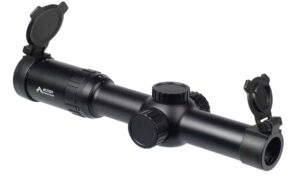
The Primary Arms SLx 1-6x24mm LPVO consistently ranks among the top budget contenders on modern carbines. What stands out is the reticle options, especially the innovative ACSS designs in the second focal plane. Popular choices like the ACSS Nova use a fiber wire for ultra-bright red dot illumination visible even in harsh sunlight, paired with a clean center aiming point and intuitive holdovers for ranging, wind, and moving targets.
The ACSS Aurora offers yard- or meter-based BDC hashes calibrated for common calibers like 5.56 or .308, keeping the view uncluttered at low power yet functional at max zoom. Eleven illumination levels work effectively from dawn to dusk, and the etched reticle stays usable without battery.
Upgraded glass in Gen IV provides impressive clarity and light transmission for the class, with minimal distortion and a forgiving eye box. The integrated throw lever ensures quick power changes, and generous eye relief suits dynamic positions. This scope dominates the value category by offering daylight-bright illumination, smart ACSS reticles, reliable tracking, and practical features for typically $300-400
Pros
- Innovative ACSS reticles
- Clear, upgraded glass with excellent transmission
- Lightweight, durable build that holds zero reliably
- Generous eye relief and forgiving eye box
- Outstanding value with lifetime warranty
Cons
- Turrets offer average tactile feedback
- Not as premium in low-light as higher-end glass
7) Swampfox Arrowhead 1-10×24 SFP LPVO
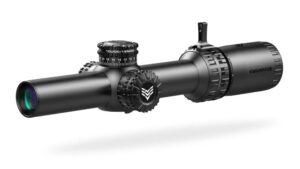
Swampfox really shook things up when they dropped the Arrowhead 1-10×24 SFP LPVO, a no-nonsense package that doesn’t cost an arm and a leg. The scope’s popular BDC reticle features a bold horseshoe around a fine center dot for lightning-fast acquisition at 1x, plus lower chevrons and hashes calibrated for 5.56 or .308 drop out to 800 yards. Illumination comes in red or green with 12 levels, including NV-compatible settings, and it’s bright enough for most daylight use while the etched glass keeps it visible when off.
At true 1x, the view is wide and forgiving, almost red-dot quick, and cranking to 10x brings surprising clarity for target ID or precision holds. The included throw lever makes power changes effortless, and eye relief stays consistent.
What makes the Arrowhead such a killer value is delivering high-end touches like clear multi-coated glass, reliable tracking, and that versatile reticle setup for usually $400-500, often less on sale, while stacking up against scopes priced hundreds more.
Pros
- Practical Guerrilla Dot reticle
- Rugged build with locking turrets and included throw lever
- Generous eye relief and consistent performance
- NV-compatible settings and strong durability
- Outstanding value in a 1-10x LPVO
Cons
- Some minor fisheye or edge distortion at 1x
LPVO Scopes Buying Guide
Besides the value for money, these are some of the things to consider when looking for an LPVO scope.
-
-
Magnification
-
Magnification controls how close your target appears. Lower magnification is great for close to medium-range hunting because it gives a wider field of view and faster target acquisition. Higher magnification is better for long-range shooting, but it can make the image shakier and darker. The best magnification depends on how far you normally shoot and what you’re shooting.
-
-
Objective Lens Size
-
The objective lens is the front lens of the scope. A larger lens lets in more light, which makes the image brighter, especially at dawn or dusk. However, bigger lenses also make the scope heavier and bulkier. Most hunters find lenses between 32mm and 50mm to be a good balance between brightness and weight.
-
-
Reticle (Crosshairs)
-
Reticles come in different styles such as simple crosshairs, BDC (bullet drop compensation), and mil-dot designs. A simple reticle is easier for beginners, while advanced reticles help with estimating distance and bullet drop. Illuminated reticles can help in low light but may feel distracting to some shooters. Choose one that matches your skill level and shooting style.
-
-
First Focal Plane vs Second Focal Plane
-
In a first focal plane (FFP) scope, the reticle changes size as you zoom, so the holdover marks stay accurate at any magnification. In a second focal plane (SFP) scope, the reticle stays the same size, which many people find easier to see, but holdover marks are only accurate at one magnification. Think about whether simplicity or precision matters more to you.
-
-
Durability and Weather Resistance
-
A good scope should handle recoil, bumps, and rough field conditions. Look for scopes that are waterproof, fog-proof, and shock-resistant. Nitrogen-purged or argon-purged scopes prevent internal fogging. A strong aluminum body also helps the scope last longer. Durability is especially important for hunting or harsh environments.
-
-
Eye Relief
-
Eye relief is the distance your eye needs to be from the scope to see a clear image. Longer eye relief (3–4 inches or more) is safer, especially on rifles with heavy recoil, because it prevents the scope from hitting your face. It also makes shooting more comfortable, especially for people who wear glasses.
-
-
Turrets and Zero Retention
-
Turrets are the knobs you turn to adjust windage and elevation. Good turrets should be precise, easy to turn, and able to hold zero even after shooting many rounds. If a scope loses zero easily, your shots will be inconsistent. Some scopes also offer zero-stop features, which help you return to your original setting quickly.
-
-
Size, Weight, and Balance
-
Heavier scopes can make your rifle feel unbalanced and tiring to carry, especially for hunting. Lightweight scopes are easier to handle but may have fewer features. It’s important to find a scope that balances well with your rifle and feels comfortable when aiming.
Frequently Asked Questions (FAQs)
Are LPVOs worth it?
Yes, LPVOs (Low Power Variable Optics) are worth it for many shooters because they offer true versatility. At low power, like 1×, they work almost like a red-dot for fast close-range shooting. When you zoom in, you get enough magnification for medium-range accuracy.
The only downsides are added weight and usually higher cost compared to simple red dots, but the flexibility you gain makes them great for most real-world shooting situations.
Related