
When you are looking to push your rifle’s effective range out to 300 yards or more, a magnifier isn’t just a luxury; it is a critical piece of hardware that demands high-quality glass and a rock-solid mount. The market is currently flooded with options, but the following six models represent the pinnacle of various categories, from battle-ready tanks to ultra-light micro units.
Here is a deep dive into the technical specifications and field performance of the best magnifiers for red dots.
Best Magnifier for Red Dots -Reviews
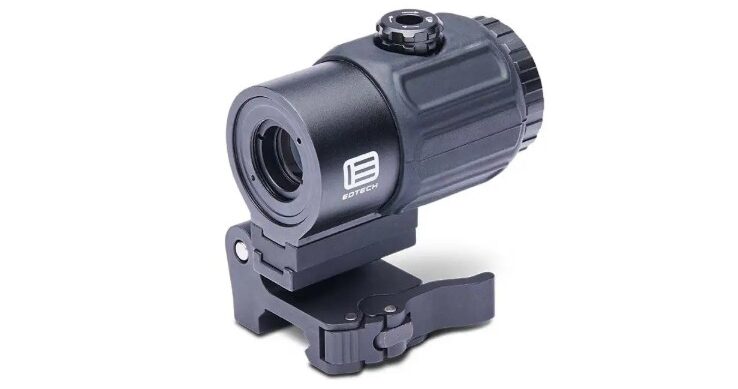
1) EOTech G-Series G33 3x Magnifier
The EOTech G33 is widely considered the industry standard for professional use, and it stands out primarily due to its legendary durability and its exceptionally fast Switch-to-Side (STS) mount.
While many competitors use buttons or latches that can be difficult to manipulate under stress or with gloved hands, the G33 relies on a robust tension-fit mechanism. You simply slam it into place or flick it aside. Inside the housing, the glass is noticeably superior in terms of light transmission and color fidelity. Because it was designed to pair with holographic sights, which have no parallax issues, the G33 provides a perfectly centered, crisp image that doesn’t distort the reticle.
The tool-free windage and elevation dials are another standout feature; they allow you to center the red dot within the magnifier’s field of view using only your fingers, which is a massive advantage when switching the unit between different rifles in the field.
Pros
- Superior glass clarity with high-end coatings for low-light performance
- Fastest mounting system on the market with the STS flip-to-side base
- Built to withstand extreme environmental conditions and heavy recoil
- Tool-free adjustments make setup and zeroing incredibly simple
Cons
- Eye relief is relatively short at 2.2 inches, requiring a specific stock position
- It commands a premium price that reflects its duty-rated status
2) Aimpoint 3X-C Magnifier
Aimpoint is the pioneer of the red dot sight, so it makes sense that their 3X-C magnifier is engineered for seamless integration. It stands out because of its modularity and its heritage of reliability. Although it is marketed as a more entry-level professional optic, the internal glass is essentially the same high-quality material found in their full-blown military models.
One of the most unique aspects of the 3X-C is its 30mm tube design encased in a shock-absorbing rubber armor. This not only protects the aluminum body from impact but also allows you to use a wide variety of aftermarket 30mm mounts. This means you aren’t stuck with one manufacturer’s mounting height; you can swap it into a high-rise mount or a quick-detach ring depending on your specific needs. The image is flat and clear from edge to edge, which is exactly what you need when trying to identify a target at 200 yards through a 2MOA dot.
Pros
- Exceptional edge-to-edge clarity with no noticeable fish-eye effect
- Rubberized exterior provides a secure grip and extra impact protection
- Compatible with any 30mm mount, offering unmatched customization
- Variable diopter allows for precise focus adjustment for different eyesight
Cons
- Does not typically include a mount, which can drive up the total cost
- Lacks the convenient tool-free adjustment dials found on its EOTech rival
3) Holosun HM3X 3x Magnifier
The Holosun HM3X has effectively disrupted the optics world by providing features that were previously exclusive to high-end units. It stands out most notably for its generous eye relief. At 2.8 inches, it offers the most forgiving eye box of any magnifier in this lineup, meaning you don’t have to tilt your head right up against the optic to see a full image.
This makes it much more comfortable for rapid target transitions. The build quality is surprisingly high, featuring a titanium-plated or high-strength aluminum housing that feels dense and durable. Another major standout is the included mount; it features a quick-detach (QD) lever and a spacer that allows you to switch between absolute co-witness and lower 1/3 co-witness heights right out of the box.
For a shooter who wants a complete, high-performing kit without doing extra homework on mounts and spacers, this is the most logical choice.
Pros
- Most generous eye relief in the category, leading to faster target acquisition
- Includes a robust QD mount and height-adjustment spacers
- Built-in adjustment tool on the windage and elevation caps
- Extremely competitive pricing for the level of optical performance provided
Cons
- Noticeably longer and heavier than the micro-sized competitors
- The flip-to-side hinge can be quite stiff when the unit is brand new
4) Vortex Micro 3x22mm Magnifier
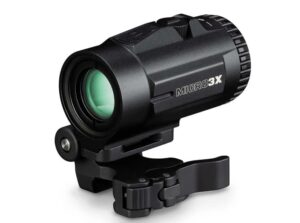
Vortex listened to the demands of shooters who were tired of bulky optics taking up the entire top rail of their rifles. The Micro 3x stands out because it is roughly 30% smaller than a traditional 3x magnifier while maintaining a high level of light transmission. This tiny footprint is essential if you want to run a rear flip-up iron sight or if you need more room to operate your charging handle.
Despite its size, the glass is remarkably bright, and the field of view is surprisingly wide. The mount is another highlight; it is fully ambidextrous, allowing you to flip the unit to the left if you are a left-handed shooter or if you just prefer that orientation. Perhaps the biggest selling point is the Vortex VIP Warranty. Knowing that the company will repair or replace the unit for free, regardless of how it was damaged, makes this a very safe long-term investment.
Pros
- Minimalist design saves valuable rail space and reduces rifle weight
- Ambidextrous mounting options for left or right-side deployment
- Very bright image with a wide field of view for such a small objective lens
- Backed by the best lifetime warranty in the optics industry
Cons
- Small size results in a very tight eye box
- The mount uses a screw-down system rather than a quick-detach lever
5) Primary Arms SLx 3x21mm Micro Magnifier
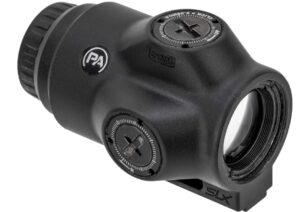
Primary Arms is known for thinking outside the box, and their SLx Micro stands out because it adds a layer of intelligence to your red dot system. You can choose a version with their ACSS Pegasus ranging reticle etched into the glass. This is a game-changer.
While other magnifiers just make the dot bigger, this one gives you a series of lines that allow you to range a human-sized target out to 500 yards. It is incredibly lightweight, weighing in at only 5.3 ounces, which is almost unnoticeable on a standard carbine. The housing is made of 6061-T6 aluminum and is designed to be waterproof and fog-resistant. For the weight-conscious shooter who wants to add a scouting capability to their rifle without the bulk of a variable power optic, the SLx Micro is an incredibly efficient solution.
Pros
- Available with a ranging reticle that adds significant tactical utility
- One of the lightest 3x magnifiers currently available on the market
- Small footprint allows for easy mounting on compact PDWs or SBRs
- Very affordable, making it accessible for budget-conscious builds
Cons
- The light transmission isn’t quite as high as the premium EOTech or Aimpoint glass
6) SIG SAUER Juliet 3-Micro RDS Magnifier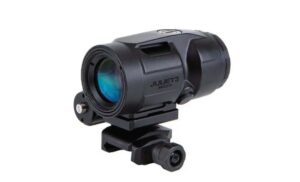
The Juliet 3-Micro is a ruggedly built optic that stands out for its mechanical security and high-quality prism glass. Unlike tension-based systems, Sig uses a 90-degree push-button flip-to-side mount. This means the magnifier is physically locked in place until you intentionally depress the button.
This is a huge benefit for anyone who plans on running their rifle hard through thick brush or during high-movement drills where a tension mount might accidentally get knocked out of alignment. The glass utilizes a dielectric coated prism, which ensures that colors remain vivid and the image stays bright even in overcast conditions. It is built from aircraft-grade aluminum and comes with several different spacers, making it one of the easiest magnifiers to align with a variety of different red dot heights.
Pros
- Highly secure push-button mount prevents accidental deployment
- Prism glass with dielectric coatings provides excellent light and color
- Very durable construction designed for hard-use environments
- Includes multiple spacers to ensure perfect height alignment with your red dot
Cons
- The push-button can be slightly slower to operate than a simple flip-to-side system
- It is a bit heavier than some of the other micro-sized options
Magnifier for Red Dot Buying Guide
Once you start digging into the specs of magnifiers, you realize that not all glass is created equal. From how close you have to put your face to the lens to how much rail space you are willing to sacrifice, several mechanical and optical trade-offs will define your shooting experience. Here is what I look for when I am putting a new unit on my rail.
Eye Relief
Eye relief is arguably the most critical factor because it determines how you actually have to stand and hold your rifle. This measurement is the distance between your eye and the rear lens where you can still see a full, clear image.
A short eye relief, forces you to crane your neck forward or move the optic as far back on the rail as possible, which can interfere with your charging handle. I always look for something that offers a bit of a buffer so I can maintain a natural, comfortable cheek weld without feeling like the optic is going to hit me in the face under recoil.
Optical Clarity
Since you are looking through two different pieces of glass, the red dot and the magnifier, the quality of that glass becomes twice as important. Cheap glass can lead to a dim image, weird color shifts, or a blurry dot that looks more like a starburst than a precision aiming point.
You want a lens that has high-quality coatings to maximize light transmission, especially if you plan on shooting at dawn or dusk. When testing a magnifier, look at the very edges of the image; if it is blurry or distorted at the periphery, it is going to be distracting and make target identification much harder than it needs to be.
Mounting System
The mount is the backbone of the entire system because it is the part you will actually be interacting with the most. There are two main styles: the push-button lock and the simple tension-fit. Push-button mounts are incredibly secure and won’t move unless you want them to, but they can be slower to operate under pressure.
Tension-fit mounts allow you to just grab the optic and flip it in or out of the way, which is much faster for rapid transitions. Pay attention to whether the mount is a quick-detach style, as being able to strip the extra weight off the rifle in seconds without tools is a huge plus for a versatile build.
Footprint and Weight
Every ounce you add to your rifle matters, especially when that weight is sitting high up on the rail where it can make the gun feel top-heavy and sluggish. Modern micro-magnifiers have become incredibly popular because they offer the same 3x boost as older models but in a package that is half the length and significantly lighter.
A smaller footprint also leaves you more room for backup iron sights or laser aiming devices. I try to find a balance where I am not adding a literal brick to the side of my rifle just for a bit of extra zoom, as a nimble rifle is always more enjoyable to shoot.
Height Compatibility
Nothing ruins a sight picture faster than a magnifier that doesn’t line up perfectly with your red dot. Most optics sit at either absolute co-witness or lower 1/3 co-witness heights, and your magnifier needs to match that exactly. If the heights are mismatched, you will see a dark shadow at the bottom or top of your view, or your dot will be frustratingly off-center.
Always check to see if a magnifier comes with spacers or risers in the box. Having that adjustability means you aren’t stuck buying an expensive aftermarket mount just to get a clear view through the dot you already own.
Durability
A magnifier is an exposed piece of equipment that is designed to be flipped off to the side, where it is prone to getting bumped against doorways, barricades, or gear. You want a housing made of high-strength aluminum, and more importantly, it needs to be properly sealed against the elements.
Look for an IP rating that guarantees it is waterproof and nitrogen-purged to prevent internal fogging when you move from a warm car into the cold woods. If the optic can’t handle a sudden rainstorm or a rough day at the range without fogging up, it is essentially dead weight on your rifle.
Related Articles