
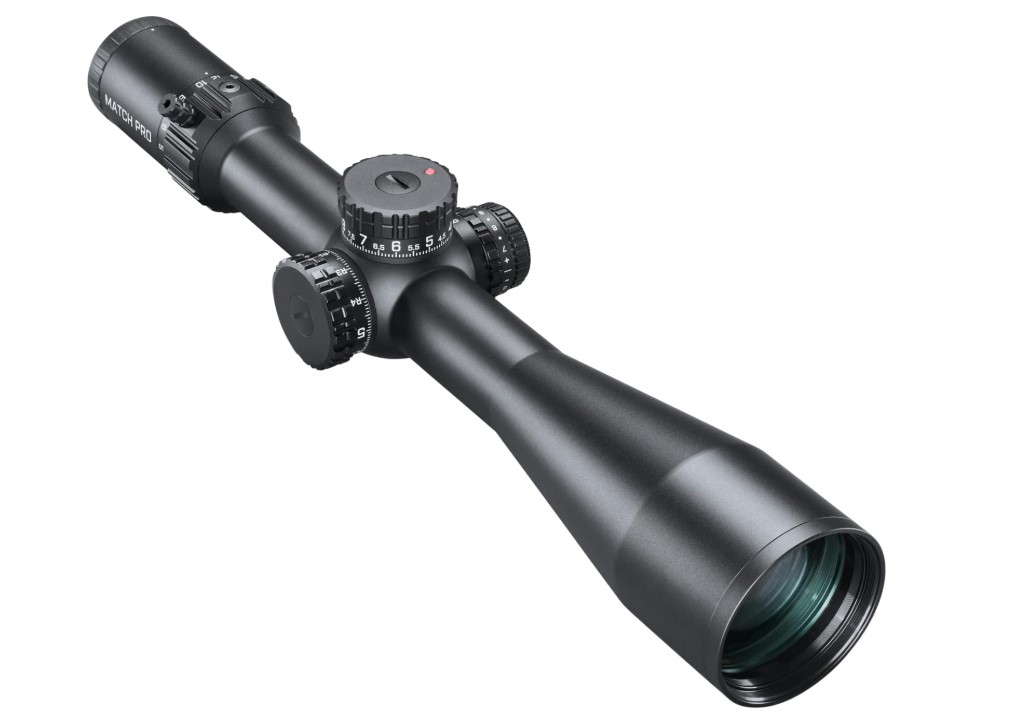
The Bushnell Match Pro ED 5–30×56 is one of those optics that quietly rewrites expectations for the sub-premium bracket. It borrows features you’d usually associate with pricier competition scopes, ED glass, a robust 34 mm tube, a true zero stop, locking turrets, refined illumination, and a modern grid reticle, and packages them into a tool purpose-built for PRS/NRL, rimfire matches, and long-range target work.
If you’re stepping up from a budget FFP optic or trying to wring more performance out of a .22 LR trainer without mortgaging your centerfire rig, this scope lands squarely in the “sweet spot.”
Optics & Glass Quality
Bushnell anchors this model around ED (Extra-low Dispersion) Prime glass and a 56 mm objective. The on-paper promise is reduced chromatic aberration (that color fringing you notice around high-contrast edges) and better contrast in the low-angle light we so often shoot in at matches.
In practice, the image has the crisp, neutral look that helps you call imperfect impacts on painted steel and pick out traces against complicated backdrops. The big 56 mm aperture isn’t just for vanity; it translates to a forgiving eyebox through much of the magnification range and a touch more confidence when the light flattens late in the day.
Color rendition leans natural, not overly warm or cool, and resolution holds together surprisingly well into the top third of the zoom.
Like most scopes in its class, you’ll see a mild dip in micro-contrast at absolute max power, but detail stays usable for spotting small plates or tight KYL racks. Depth of field feels appropriate for the magnification, and focus “snaps” when parallax is set correctly.
Specifications |
|
|
Magnification Range & Parallax
The 5–30× span is a big part of the story here. At the low end, 5× still gives you situational awareness when running closer targets or when you need a wider field for troop lines. At the high end, 30× delivers the scale you want for exacting holds or when you’re reading mirage at longer distances.
Importantly, the parallax focuses down to around 15 yards, which is a huge advantage for NRL22 stages or zeroing at short indoor ranges. If you’ve ever fought a scope that won’t resolve at 25 yards, you’ll appreciate how much easier this makes life on a rimfire trainer.
Reticle & Illumination
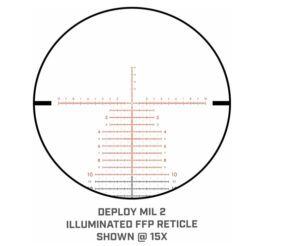
Bushnell offers the scope with the Deploy MIL 2 (DM2) reticle, a modern “2/10” MIL tree with 0.2 MIL hash intervals and an illuminated center section that’s subtle enough for precision holds without flaring. DM2 is a thoughtful evolution of their popular Deploy MIL: clean vertical and windage stadia, a useful tree for wind brackets, and references that make mover leads and quick holdovers intuitive. Illumination has 11 brightness settings and, crucially, an auto-off (six-hour) timer. That seemingly tiny detail keeps you from finding a dead battery on match day.
If you prefer a busier competition tree, Bushnell also offers a G5i version co-developed with GA Precision, with additional 0.1 MIL subtensions and mover marks. Shooters who live on holdovers for entire stages will appreciate the extra structure.
Turrets, Tracking & Zero Stop
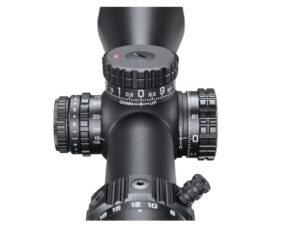
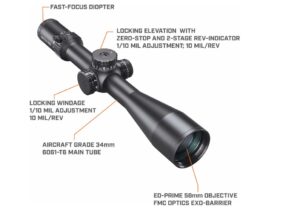
Tactile, positive turrets are non-negotiable on a match optic, and the Match Pro ED delivers here. The exposed, locking turrets give you crisp, repeatable clicks and the peace of mind that your elevation won’t spin off in a barricade transition
Internally, the scope rides on a 34 mm main tube that buys you a generous 30 MIL (≈103 MOA) of elevation travel and 14.5 MIL of windage, ample for pushing a 6 mm Creedmoor deep or doing silly things with a 40 gr .22 LR subsonic when you’re practicing holds to the horizon.
Bushnell’s Easy-Set zero stop is straightforward, reliable, and quick to set; once installed, getting back to your hard zero between stages is foolproof.
Bushnell’s Match Pro line has a good reputation for tracking accuracy, and this ED variant continues that lineage.
Box tests and tall-target checks from early adopters have been boringly consistent, which is exactly what you want: spin to a number, return to zero, repeat, no drama. That, coupled with the tactile “revolution indicator,” makes it difficult to get lost in the turret in the heat of a stage.
Ergonomics & Build
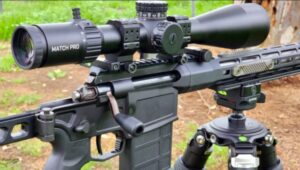
The scope comes in at roughly 32 oz, which is middle-of-the-road for a 56 mm, 34 mm-tube competition optic. While there are lighter options, the weight aids stability on wobbly props and doesn’t feel punitive on a purpose-built match rifle.
The housing is IPX7 waterproof and nitrogen-purged for fogproofing, and Bushnell includes practical touches like a 2.5″ sunshade, a fast-focus eyepiece, and a three-position throw lever that you can position to your preference for speed on magnification changes.
Fit and finish feel premium for the money: subdued texturing where you need grip, sensible knurling that won’t shred gloves, and clear, legible markings.
The locking mechanism for the turrets engages with positive feedback no hunting around for a half-engagement or mushy detent.
Performance In The field
- Rimfire trainers (NRL22/PRS .22)
This is where the scope really shines. The close parallax, wide magnification range, and DM2 grid make it deadly for small KYL racks, 1/4-MOA plates, and awkward holdover stages.
Being able to resolve tiny plates at 25–50 yards on 20–25× with perfect parallax takes stress out of stage planning. Rimfire trajectories are steep; the 30 MIL internal elevation means you can dial a sane baseline and hold the rest without running out of turret.
The illumination levels are restrained enough that your center doesn’t starburst on dark targets.
- Centerfire (PRS/club matches/hunting crossovers)
On a 6 mm Creedmoor or 6.5 CM, the glass and turret mechanics hold up well to high-round-count practice days. Return-to-zero remains repeatable after long dialing sessions, and the scope seems indifferent to temperature swings.
At 30× in thick mirage, you’ll likely live between 14× and 20×, but having the headroom to punch in for fine target confirmation is valuable. Many shooters consider this one of the strongest performers “under a grand,” noting that the combination of features and reliability punches above class.
Mounting & Setup Notes
Rings/Bases
You’ll need 34 mm rings; many shooters pair it with a 20–40 MOA base depending on caliber and intended distances. For extreme rimfire fun, you may stack cant in base + mount to use more of the 30 MIL travel without living at the top of the turret.
Eye Relief & Eyebox
The eyebox is generous in the mid-range and reasonable at 25× and up; spend time setting diopter correctly so the reticle is razor-sharp before you judge high-mag eyebox harshly.
Illumination Battery
The 6-hour auto-off helps, but make battery changes part of your pre-major-match checklist.
Comparisons & Value
In the “value competition” lane, the Match Pro ED 5–30×56 typically gets cross-shopped against optics like the Viper PST Gen II 5–25×, Arken EP5, Athlon Ares-class scopes, and Primary Arms GLx/PLx tiers. The Bushnell’s case rests on four pillars:
- Feature density without gimmicks (true zero stop, locking turrets, 34 mm tube, illumination with auto-off).
- Close parallax capability that makes it uniquely attractive for rimfire.
- Credible tracking reputation rooted in the Match Pro lineage.
- ED glass and a forgiving 56 mm objective that keep the image clean through most of the zoom range.
- Street prices often hover under the four-figure mark, making it a strong value in its segment.
Where It Could Improve
No scope is perfect, and there are a few trade-offs to keep in mind
- At max power (30×), like many peers, micro-contrast softens a bit in heavy mirage or flat light, dialing back to the high teens usually restores snap.
- The weight is purposeful but not feathery; dedicated mountain hunters might prefer something lighter with capped turrets.
- If you’re a connoisseur of ultra-buttery glass in the $2–3k class, you’ll still notice the difference in edge performance and flare control under the harshest lighting.
Who It’s For
- NRL22/PRS.22 competitors wanting one optic that covers 25 yards to 400 m without parallax headaches.
- Centerfire match shooters building a sensible, reliable training or club-match rig that tracks perfectly, dials cleanly, and won’t punish the wallet.
- Crossover precision hunters who occasionally compete, provided they’re fine with the weight and prefer locking, exposed turrets.
- If you live by holds, choose DM2 for a clean, readable tree. If your stages are hold-heavy and mover-focused, the G5i reticle is worth a look.
Pros & Cons
Pros
- ED Prime glass with a 56 mm objective delivers strong clarity and a forgiving eyebox; minimal color fringing for the class.
- 5–30× magnification with parallax down to ~15 yds—ideal for rimfire and short-bay practice.
- 34 mm tube with ~30 MIL elevation and 14.5 MIL windage gives ample travel for both rimfire and centerfire.
- Easy-Set zero stop, locking exposed turrets, and a revolution indicator—match-ready controls that stay put.
- DM2 illuminated reticle with 11 brightness settings and 6-hour auto-off prevents battery surprises and keeps the center usable on dark targets.
- IPX7 waterproof, nitrogen-purged, includes sunshade and three-position throw lever; practical, range-ready kit.
- Strong tracking reputation for the Match Pro line; returns to zero reliably.
Cons
- 32 oz weight isn’t ideal for ounce-counting mountain hunts.
- At 30×, image micro-contrast diminishes in heavy mirage (common in this class).
- Glass quality is excellent for the price, but premium $2k+ optics still outpace it in edge performance and flare control.
- 34 mm rings required; some shooters may need taller mounts for 56 mm objective clearance on certain rails and chassis.
Verdict
The Bushnell Match Pro ED 5–30×56 nails the modern “value-match” brief. It’s accurate in the ways that count, tracking, return-to-zero, and repeatable mechanics, and generous in the ways that make your day easier, close parallax, a smart illuminated tree, and plenty of elevation.
Add ED glass, a sensible control layout, and real-world durability, and you’ve got a scope that punches above its weight for the precision games most of us actually shoot.
If you’re building an NRL22 rig, a practical PRS trainer, or a club-match rifle that needs to perform every weekend without anxiety, the Match Pro ED belongs at the top of your list.
It’s not trying to be a boutique, halo-glass optic; instead, it’s the dependable match partner that shows up, dials true, and helps you focus on stage planning rather than fighting your equipment.
In a segment crowded with promising spec sheets, Bushnell’s execution here is refreshingly complete, and that’s what ultimately wins matches.
Related