
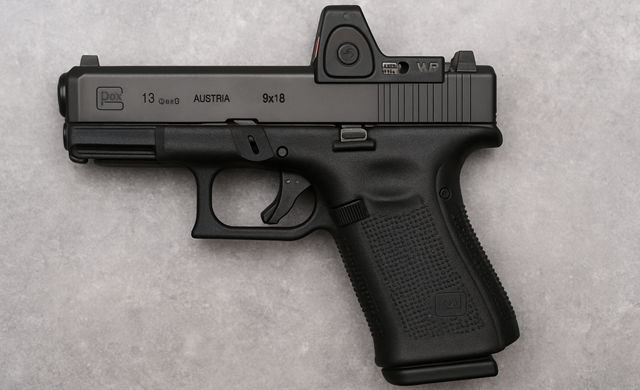
If you own a Glock 19 Gen 5, you already appreciate a compact, capable handgun that’s become a standard for everyday carry, range fun, and duty use.
Adding a quality pistol red dot transforms that platform, giving you faster target acquisition and better accuracy under pressure. But not all micro red dots are created equal. Footprints, durability, window size, battery life, and holster compatibility are all different.
This guide breaks down the best red dots I recommend for the Glock 19 Gen 5 so you can pick the optic that’s actually valuable.
Here is a quick recap;
- Trijicon RMR Type 2
- Holosun 507K X2
- Leupold DeltaPoint Pro
- Shield Sights RMSc
- Vortex Viper
- Trijicon SRO
Best Red Dot for Glock 19 Gen 5- Top Picks
1) Trijicon RMR Type 2
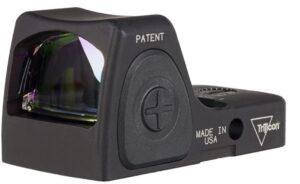
Trijicon’s RMR is the pistol-red-dot many competitors measure themselves against. The Type 2 RMR is a combat-grade miniature reflex sight with a proven track record on handguns, duty pistols, and competition firearms.
It’s made from a robust forged aluminum housing with a protective hood, and it’s designed to survive real abuse drops, impacts, recoil, and the occasional blunt trauma most pistol sights never see outside a range.
The RMR Type 2 offers multiple reticle options (0.5 MOA dot up to 3.25 MOA triangular dot), an extremely crisp dot, and very fast target acquisition thanks to its clear, low-parallax window.
Battery life varies by reticle and brightness but it is competitive. There are also solar-assist models. Adjustments are precise and hold zero well.
Because the RMR’s footprint is the same as many OEM and aftermarket Glock plates, it fits widely available adapter plates and MOS slides.
Pros
- Extremely durable and combat-proven.
- Very crisp, easy-to-see dot with low parallax.
- Wide footprint support and many mounting options.
- Several reticle sizes to choose from.
Cons
- Pricier than many competitors.
2) Holosun 507K X2
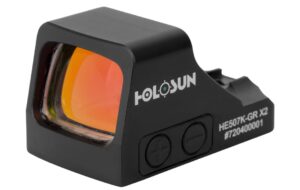
Holosun’s 507K X2 is a micro reflex designed specifically with compact pistols and concealed carry in mind. It blends modern features with a compact footprint that fits many Glock mounting plates.
Holosun’s value proposition is excellent, with advanced features like shake-awake, multiple reticle choices, and long battery life being standard. The glass is also very clear, and this sort of helps with astigmatism
The sight is built from forged 7075-T6 aluminum, rated IP67 for dust and water resistance, and uses an open-emitter design for a bright, high-contrast dot.
It has a side battery tray for quick battery changes without removing the optic, user-selectable auto or manual brightness modes, and a Lock Mode to prevent accidental adjustments.
Pros
- Excellent value for money with modern features.
- Long battery life and solar backup.
- Multiple reticle options for personalization.
- Compact, pistol-friendly footprint.
Cons
- Controls may be fiddly for some users with gloves.
3) Leupold DeltaPoint Pro
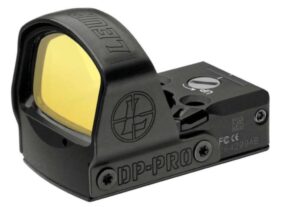
Leupold built the DeltaPoint Pro to combine the optical excellence Leupold is known for with a pistol-friendly micro reflex form factor. With the use of Twilight Max Light Management Systems, you get a crisp image and almost zero glare.
Where some micro dots prioritize compactness, the DeltaPoint Pro favors a larger glass window and a big field of view ideal for shooters who like to keep both eyes open and scan quickly.
The 2.5 MOA dot is easy to track in both bright and low light conditions. Moreover, it comes with a strong aluminum housing and user-friendly controls with a quick brightness dial that many shooters prefer to button arrays.
The DeltaPoint Pro also shows great battery longevity in practical use, partly courtesy of the Motion Sensor Technology (MST), which deactivates the illumination after 5 minutes of inactivity. When it’s time to change the battery, it’s easily accessible, and you don’t have to rezero once you are done.
Pros
- Large window for fast target acquisition and scanning.
- Excellent optical clarity and low distortion.
- Intuitive controls and solid battery life.
- Well-suited to both duty and competition.
- Very easy battery access
Cons
- May require slide milling or adapter plate for some Gen 5 slides.
- Slightly larger
4) Shield Sights RMSc
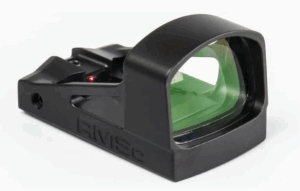
Shield Sights created the RMSc to be a slim, lightweight optic that integrates cleanly onto compact pistols.
The RMSc’s low profile and small footprint make it a favorite for concealed carry platforms like the Glock 19. It’s built with the understanding that many users want minimal added bulk while still gaining the speed advantage of a dot.
The red dot comes with either 6 MOA or 3 MOA dot options on various models, very compact housing that tucks low into the slide, and straightforward controls. The optics package focuses on no-frills reliability and clear reticle performance.
Pros
- Extremely compact and low-profile.
- Lightweight
- Designed specifically for compact pistols and holsters.
- Simple, user-friendly interface.
Cons
- some users prefer a slightly larger window
5) Vortex Viper
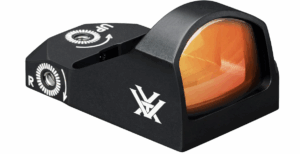
The Vortex Viper Red Dot (6 MOA) is a purpose-built reflex sight emphasizing simplicity, durability, and co-witness compatibility for handgun use.
It projects a bright, daylight-visible red dot (6 MOA) that “paints” targets reliably in various lighting and backgrounds. The Viper is built with rugged construction and features ArmorTek® ultra-hard coating on the lenses to resist scratches, oil, and dirt. It is fully multi-coated to optimize light transmission and clarity.
The sight offers a super low mounting height that enables co-witnessing with suppressor-height iron sights on slides already cut for optics.
Its battery life ranges from about 150 hours at maximum brightness to as much as 30,000 hours on lower settings, which gives flexibility for intense use and longer stretches without maintenance.
It weighs about 1.03 oz and measures 1.8 inches in length, making it compact and light enough for pistol slide mounting. The Viper comes packaged with a Weaver/Picatinny mount, CR2032 battery, protective cover, and the tools needed for installation and adjustments, all part of its straightforward, no-nonsense approach.
Pros
- Excellent value and warranty.
- Solid optical clarity and user ergonomics.
- Good balance of features for price.
- Simple controls and adjustments with 1 MOA increments
- Bright 6MOA red dot
Cons
- Lacks advanced features (solar assist, motion activation) present in some competing sights
6. Trijicon SRO
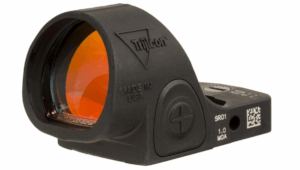
The Trijicon SRO (Specialized Reflex Optic) is designed to provide pistol shooters with the largest possible sight picture for the fastest target acquisition.
Its wide rectangular lens provides an expansive field of view that makes tracking moving targets and reacquiring the dot after recoil noticeably quicker than most micro-dots.
The housing is forged from 7075-T6 aluminum for strength, and the sight features a crisp LED-projected dot available in multiple sizes, allowing shooters to prioritize precision or speed.
Brightness is user-selectable across several levels and includes night-vision compatible settings; a “super bright” option helps in very sunny conditions.
The SRO’s top-loading battery access simplifies swaps, and windage/elevation adjustments are positive and fine-stepped for reliable zeroing. It’s designed to be parallax-free at typical pistol ranges and works well with suppressor-height iron sights.
Tradeoff; the SRO is larger than many micro reflexes, which affects holster compatibility and may require a milled slide or adapter plate for a flush fit.
Pros
- Very large window and fast target acquisition.
- Excellent optical clarity and anti-reflective coatings.
- Multiple dot sizes for precision or speed preferences.
- strong and durable.
- Top-loading battery access for easy swaps.
- NV-compatible and high-brightness settings.
Cons
- Larger footprint and taller profile than micro dots.
- May require slide milling or adapter plate for flush mounting.
Glock 19 Red Dot Buying Guide
Footprint & Mounting
Footprint determines whether an optic can be bolted to your Glock slide natively or requires an adapter plate or slide milling.
Some dots use standardized footprints that match Glock MOS plates; others require specific custom plates.
If your Glock 19 Gen 5 does not have an MOS/milled slide, you’ll either need to have the slide cut by a gunsmith or purchase an adapter plate that fits your slide and the optic. Always check the manufacturer’s mount compatibility before buying to avoid surprises.
Build Quality
A carry pistol endures drops, holster rub, and repeated recoil. Durable construction forged or CNC aluminum housing, protective hoods, sealed internals for water and dust resistance matters.
Some designs deliberately reduce exposure to debris; others rely on tough open housings (RMR) and proven materials. If you plan to use your Glock for duty or harsh conditions, prioritize ruggedness.
Reticle Type and Size
Reticle size affects precision and speed. Small dots (1–2 MOA) offer pinpoint precision for longer shots; larger dots (3–6 MOA) speed up acquisition at short distances and are forgiving in dynamic shooting.
Some optics offer circle-dot combos for rapid alignment. Consider your typical engagement distances and whether you prefer pinpoint accuracy or instinctive fast aiming.
Window Size & Field of View
Window size affects how quickly your eye finds the dot and how much environmental context you see. Large windows excel at scanning and follow-up shots.
Smaller windows reduce bulk and holster interference but can constrain peripheral view. Decide whether you value maximum speed/awareness or a minimal footprint for concealment.
Battery Life & Backup Options
Some red dots provide thousands to tens of thousands of hours of battery life; others include solar backup or motion-activated “shake awake” modes to conserve power.
Consider how easy the battery is to replace in the field and whether the optic offers mechanical backup in case of failure. For defensive carry, longer battery life and backup options reduce the chances of an unexpected outage.
Controls & Brightness Adjustments
Controls should be intuitive and usable under stress. Large, tactile buttons or dials are easier to operate than fiddly small buttons, especially with gloves.
Brightness settings should accommodate bright daylight and low-light conditions without blooming the dot. Auto-brightness and memory settings help, but simplicity and reliability are paramount for defensive use.
Holster Compatibility & Height
Not all holsters fit every optic. Some red dots sit higher and require holsters explicitly cut for that profile; others tuck low and work with many off-the-shelf holsters. Slide height also affects whether your iron sights can be used as a backup.
Frequently Asked Questions
Do I need my Glock 19 Gen 5 slide milled to mount a red dot?
This depends on both your rifle’s slide and the optic’s footprint. Many micro red dots use standardized footprints that can be mounted with adapter plates specifically designed for non-MOS slides.
However, for the cleanest, lowest profile mount and optimal durability, having the slide milled for an MOS footprint or for the specific optic is common. If you want a factory-level fit and minimal stacking height, consult a reputable gunsmith or consider an MOS-ready slide.
How do I zero a red dot on a Glock 19 Gen 5?
Zeroing a pistol red dot is similar to a rifle. Mount the optic securely, fire groups at a known distance (commonly 15 yards for pistols), and adjust windage and elevation until your point of aim equals point of impact.
Start with a 3–5 shot group to establish where the dot sits, then tweak adjustments and confirm with follow-up groups. Always confirm zero at distances you expect to use the pistol at.
Will a red dot change my holster options for concealed carry?
Yes, many red dots change the slide profile and require holsters specifically cut for that optic and model. Some low-profile dots fit into a wider array of holsters, but larger windows or taller housings will need dedicated holsters for secure retention and draw.
If you rely on a particular holster, check the manufacturer’s compatibility list or plan to purchase an optic-specific holster.
How often should I check or replace the battery?
Check the battery health regularly, at least monthly if the pistol is carried daily, and before any critical use. Replace batteries proactively if you notice brightness issues or after long periods of storage.
Many optics advertise long battery lifespans, but extreme temperatures, frequent high-brightness use, and age reduce life. Keep a spare battery in your range bag or carry kit and know how to change it quickly.
Can I still use iron sights with a red dot on my Glock?
Yes, many shooters use iron sights as backup. Some optics are low-profile enough for co-witness with the factory sights, while others require taller suppressor-height sights.
If you want iron-sight backup, plan your mount height so the irons remain usable ,or install suppressor-height backup sights. Always practice transitioning between dots and irons so it’s smooth under stress.
Is a larger window always better?
Not necessarily. A larger window improves situational awareness and scanning speed, which is excellent for dynamic shooting and competition.
However, large windows increase the optic’s footprint and may complicate concealment and holster selection. Smaller windows reduce profile and can be easier to package on compact slides, but they slightly limit peripheral visibility.
Final Thoughts
Choosing the best red dot for a Glock 19 Gen 5 is a balance of various factors footprint, durability, window size, and the way you carry. The right optic will make you faster, more accurate, and more confident. Use this guide to match your priorities to the models above, and commit to practice. A good red dot becomes transformative only when paired with regular, focused training.
Related