
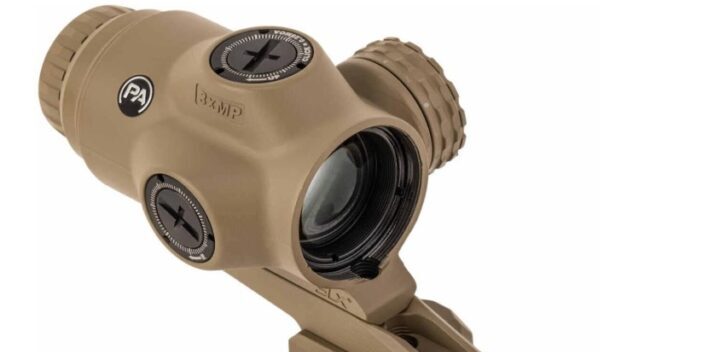
Fixed magnification optics have earned a permanent place on serious rifles because they strip away unnecessary complexity while keeping performance consistent under pressure. In survival, defensive, or field hunting scenarios, you are rarely thinking about adjusting zoom levels; you are thinking about acquiring a target quickly, identifying it clearly, and making a confident shot. That is exactly where fixed-power scopes shine. Instead of offering endless adjustability, they deliver a locked-in, reliable sight picture that performs the same way every time you shoulder the rifle.
Below is a practical, real-world breakdown of four of the most trusted fixed magnification optics available today, with an honest look at how they actually behave in use rather than just how they look on paper.
A Quick Summary
Best Fixed Power Scopes -Reviews
1) Primary Arms SLx 5X MicroPrism
See It on OpticsPlanet
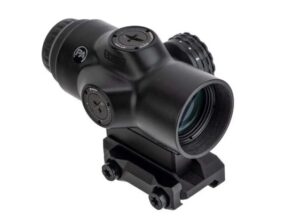
The Primary Arms SLx 5X MicroPrism feels like a modern answer to the traditional low-power combat optic. It sits in a unique category where it is neither a red dot nor a full rifle scope, but something that borrows strengths from both. In practice, the 5x magnification gives you enough reach to confidently engage targets at mid-range distances, while still maintaining a field of view that doesn’t feel overly restrictive when things get close and fast.
What makes this optic stand out most is the etched ACSS reticle. Even if the illumination is turned off or the battery dies completely, the reticle remains fully visible and functional. That alone makes it appealing for survival-oriented setups where reliability matters more than convenience. The built-in ranging and holdover system reduces the mental load under stress, allowing faster decisions without constant dialing or guessing.
In terms of handling, the optic feels solid and purpose-built. It is not the lightest option available, but that extra weight translates into durability and stability on recoil. Eye relief is more forgiving than traditional magnified scopes, though it still requires a proper cheek weld compared to a red dot. The overall shooting experience feels deliberate and controlled, especially when engaging targets at 200–500 yards where the 5x magnification starts to really show its value.
Pros
- Very clear ACSS reticle with built-in ballistic tools
- Works without battery due to etched reticle design
- Strong mid-range performance with usable field of view
- Durable construction suited for hard use
Cons
- Heavier than non-magnified optics
- Eye box is still somewhat limited under rapid movement
2) Primary Arms SLx 3×32 Compact Prism
See It on Amazon and OpticsPlanet
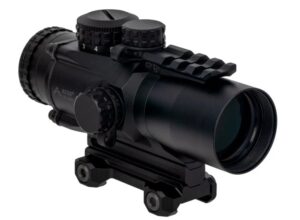
The SLx 3×32 Prism Sight is one of those optics that immediately feels natural the moment you mount it. The 3x magnification hits a very practical sweet spot where you gain meaningful target clarity without losing the instinctive speed associated with reflex sights. It is especially effective for shooters who want a single optic that can handle close quarters and mid-range work without feeling over-specialized.
The etched reticle is clean and easy to pick up, and the illumination system simply enhances visibility rather than defining it. This is important because even with the illumination off, the optic remains fully usable. In real-world use, this makes it extremely dependable for defensive rifles or field carbines where simplicity is a priority.
What really defines the 3×32 is its balance. You are not forced into the narrow engagement envelope of higher magnification optics, yet you still gain enough precision to confidently take shots well beyond typical red dot distances. The trade-off is that it will not replace a true magnified optic for long-range work, but that is not what it is designed to do. It is designed to be fast, intuitive, and consistent, and it succeeds at all three.
Pros
- Extremely fast handling with 3x magnification
- Excellent balance between speed and precision
- Reliable etched reticle usable without power
- Lightweight and compact profile
Cons
- Not ideal for precision shooting beyond mid-range
3) Vortex Spitfire HD Gen II 5x Prism Scope
See It on Amazon and OpticsPlanet
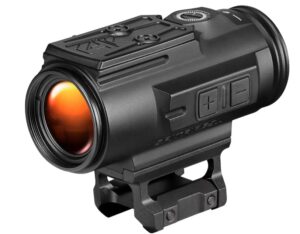
The Vortex Spitfire HD Gen II 5x is built with a clear focus on durability and straightforward performance. It feels like a tool designed for hard use rather than refinement, and that is exactly what makes it appealing to many shooters. The housing is rugged, the controls are simple, and the overall system is designed to keep working even in conditions where more delicate optics might struggle.
Optically, the HD glass delivers a sharp and clean image that makes target identification easy at mid-range distances. The reticle is uncluttered but functional, and the illumination system is strong enough to remain visible in daylight conditions without overwhelming the sight picture. This makes it a solid option for shooters who want a dependable 5x optic without unnecessary complexity.
In use, the Spitfire HD Gen II feels stable and confident. Once mounted, it holds zero reliably and does not demand constant adjustment or attention. The main compromise comes in close-range speed, where 5x magnification naturally slows down target acquisition compared to lower-power optics. However, for a designated marksman-style AR setup or a survival rifle intended for open terrain, that trade-off is often acceptable.
Pros
- Extremely durable and field-ready construction
- Clear HD glass with strong target definition
- Reliable illumination system for bright environments
- Excellent for mid-range precision roles
Cons
- Heavier than many competing prism scopes
- Eye relief is less forgiving under stress
4) Trijicon ACOG 4x32mm BAC Rifle Scope
See It on Amazon and OpticsPlanet
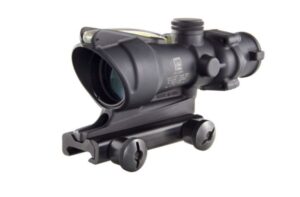
The Trijicon ACOG 4×32 is one of those optics that has earned its reputation through decades of real-world use rather than marketing. It is built around absolute reliability, and everything about it reflects that philosophy. There are no unnecessary adjustments, no dependency on batteries, and no fragile components designed for convenience over durability.
The 4x magnification is paired with the Bindon Aiming Concept, which allows shooters to keep both eyes open and effectively superimpose the reticle onto the target at close range. In practice, this gives the ACOG a speed advantage that most fixed magnification optics cannot replicate. It behaves almost like a hybrid between a red dot and a scope, depending on how you use it.
One of its most defining features is the tritium and fiber optic illumination system. This system automatically adjusts to lighting conditions without requiring any input from the shooter, and it continues to function without batteries for years. Combined with its nearly indestructible construction, the ACOG becomes one of the most dependable optics ever fielded.
The downside is cost and rigidity. It is expensive, and it does not offer the flexibility of modern prism systems. However, what it sacrifices in versatility, it more than makes up for in consistency and proven reliability under harsh conditions.
Pros
- Combat-proven durability and long-term reliability
- Battery-free illumination system
- BAC system enables fast close-range engagement
- Excellent optical clarity with proven reticle design
Cons
- High price point
- Limited eye relief compared to newer prism optics
Advantages of Fixed-Power Scopes
Mechanical Reliability
Fixed magnification optics are often overlooked in an era dominated by complex variable scopes. However, they offer a level of rugged reliability that becomes increasingly valuable as your shooting environment grows harsher. A variable-power scope relies on an internal erector tube that must smoothly slide back and forth along microscopic guide tracks when the zoom ring is turned. This movement requires fine mechanical parts, dual-focal-plane mechanics, and internal sealing O-rings that are highly susceptible to wear.
A fixed optic completely eliminates these fragile, moving components. Because the internal lenses are permanently pinned in place by the manufacturer, there are no zoom rings to bind up, no internal tracks to wear down, and no mechanical parts that can loosen under intense vibration. This robust, static architecture ensures that the internal components remain completely consistent, allowing the scope to hold its zero perfectly even after thousands of rounds of heavy, sharp recoil or severe physical impact in the field.
Rapid Target Acquisition
The physical simplicity of a fixed-power optic translates directly into faster target acquisition and engagement speeds. In high-stress situations, cognitive load plays a massive role in a shooter’s performance. With a variable scope, a shooter must constantly evaluate whether their current magnification setting is appropriate for the target’s distance, occasionally fighting a restricted field of view or an unforgiving eye box if the scope was left on a high power setting.
Fixed-power optics completely remove this hesitation. Because the magnification never changes, your brain and eye develop deep muscle memory for the exact sight picture, field of view, and border thickness the optic presents. No matter the situation, when you bring the rifle to your shoulder, the visual presentation is identical. This consistency allows for instantaneous snap-shooting and intuitive situational awareness.
True Battery Independence
Another major tactical and survival advantage of fixed-power optics is their complete independence from battery power. Many modern variable optics rely heavily on digital reticles or battery-powered illumination to remain usable, especially in low-light conditions where thin, wire reticles become invisible. If the electronics fail due to water intrusion, cold weather drainage, or a dead battery, the optic becomes significantly less effective or entirely useless.
In contrast, fixed-power optics designed for serious field use predominantly utilize deeply etched glass reticles. These reticles are physically carved directly into the lens element itself, meaning that even if any secondary illumination fails, the black reticle remains perfectly sharp and fully functional. Furthermore, many high-end fixed optics utilize passive illumination technologies, such as tritium or fiber-optic tubes, which gather ambient light to illuminate the aiming point without ever requiring a battery. For survival, tactical, or defensive use, this absolute electronic redundancy is critical.
Reinforcement of Shooting Fundamentals
Beyond the physical attributes of the hardware, fixed optics naturally encourage the development of superior shooting fundamentals. When a shooter handles a variable scope, there is a constant temptation to use magnification as a crutch, zooming in excessively to see a target better, which inadvertently magnifies the shooter’s natural body tremors and induces anxiety. This often leads to “over-aiming” and jerking the trigger.
A fixed optic forces the shooter to adapt to a consistent, unchanging magnification level. Because you cannot zoom in to make a shot look easier, you are forced to focus entirely on the core mechanics of marksmanship: stable body positioning, consistent cheek weld, proper breath control, and a clean, smooth trigger press. Over time, training with a static visual perspective builds highly disciplined habits and a more intuitive understanding of target lead and holdovers.
When to Use a Fixed-Power Scope
Predictable Environments and Defensive Rifles
Fixed-power scopes are most effective when your shooting environment is predictable enough that you can confidently accept a single magnification setting in exchange for raw speed and mechanical reliability. They excel on dedicated defensive rifles, such as modern sporting rifles or carbines, where fast target engagement within realistic defensive distances is far more critical than long-range flexibility. In a home defense or close-quarters security scenario, a low-power fixed optic ensures the rifle is always ready to deploy instantly without any need to fiddle with dials or adjustment rings under adrenaline.
Survival and Expeditionary Setups
These optics are also highly effective for dedicated survival setups, bug-out firearms, or expeditionary rifles where durability and simplicity matter much more than having a wide, versatile magnification range. When operating far from supply lines or repair facilities, the best gear is the gear with the absolute lowest probability of mechanical failure. A fixed optic can handle being bumped against rocks, dropped in the mud, or exposed to torrential downpours without losing its zero or fogging up internally, making it a dependable choice for a rifle that must work every single time under pressure.
Open-Terrain Hunting and Training
In hunting scenarios, fixed optics perform exceptionally well in open terrain, such as plains, hillsides, or predictable farmland, where shots are typically taken at known, moderate distances. A classic 4x or 6x fixed hunting scope provides a beautifully clear view for clean ethical harvests without the added weight of a massive zoom lens.
Additionally, they are commonly used in training environments and marksmanship schools. Instructors prefer them because they eliminate the distraction of adjusting magnification, allowing students to focus entirely on the course curriculum and consistent shooting habits.
Fixed-Power Scopes Buying Guide
Magnification Level
When choosing a fixed magnification optic, your very first consideration must always be the specific magnification level, because this single choice determines how the rifle will behave across all engagement distances.
- Low Power (2.5x to 3x): These options heavily favor maximum speed, an incredibly wide field of view, and close-to-mid-range versatility. They are perfect for fast-moving targets in thick brush or close-quarters defensive scenarios.
- Medium Power (4x to 5x): These choices lean more toward precision and mid-range capability. While they offer enough magnification to confidently identify and engage targets out to several hundred meters, they sacrifice some close-range agility and quick eye placement when a target is right in front of you.
Reticle Design
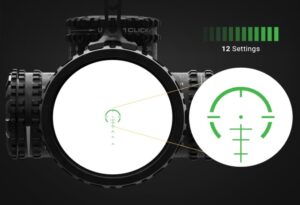
The reticle design is a critical factor because it directly influences how quickly and effectively you can process information and engage targets through the glass.
- Advanced Reticles: Options featuring Ballistic Drop Compensation (BDC) chevrons, mil-dot hashes, or windage grids can significantly improve your performance in dynamic shooting environments. They allow you to make rapid elevation holds at extended distances without ever turning your physical adjustment turrets.
- Simple Reticles: Traditional crosshairs, duplex reticles, or simple German #4 layouts prioritize absolute speed, minimalism, and a completely unobstructed view of the target. They are ideal for hunting or quick defensive reaction shooting where clutter-free glass is preferred.
Rugged Durability
Durability should never be overlooked, especially if the optic is destined for field, duty, or survival use. It is far better to own a simple, incredibly rugged optic that maintains its zero flawlessly under harsh recoil, severe weather exposure, and rough handling than a highly feature-rich, inexpensive variable scope that cannot survive real-world conditions. Look for scopes constructed from single-piece aircraft-grade aluminum tubes that are nitrogen or argon purged to guarantee absolute waterproof and fogproof performance in freezing environments.
Eye Relief and Eye Box Latitude
Finally, eye relief and eye box comfort matter significantly more than many shooters initially realize, particularly when operating under high-stress or dynamic conditions.
- Eye Relief: This is the distance your eye must be from the rear lens to see a full image. A generous eye relief prevents the scope from striking your face under heavy recoil.
- Eye Box: This refers to the physical “window” (up, down, left, and right) where your eye can reside and still maintain a clear picture. A wide, forgiving eye box ensures that even if you get a sloppy, imperfect cheek weld during a hurried or unconventional shooting position, you will still instantly get a clean sight picture without any black shadowing around the edges.
Frequently Asked Questions (FAQs)
1. What’s the Difference Between a Prism Scope and a Fixed Scope?
A prism scope is a type of optic that uses a prism instead of a traditional lens system, allowing for a more compact design and typically featuring an etched reticle that remains visible without illumination. A fixed scope, on the other hand, simply refers to any optic with a non-adjustable magnification. While most prism scopes are fixed-power, not all fixed scopes are prism-based, as some use conventional scope designs with larger bodies and different optical systems.
2. How Do You Zero a Fixed-Power or Prism Scope?
Zeroing a fixed-power or prism scope is done the same way as with any rifle optic, using the windage and elevation turrets to align your point of impact with your point of aim at a chosen distance. You begin by firing a group of shots, then make precise adjustments based on where the shots land. This process is repeated until your shots consistently hit your intended target point, ensuring reliable accuracy without needing to adjust magnification.
3. What Magnification Is Best for a Fixed-Power Scope?
The best magnification for a fixed-power scope depends on how the rifle will be used, but most shooters find that 3x to 5x offers the most practical balance. Lower magnification, such as 3x, allows faster target acquisition and better awareness at closer ranges, while higher magnification improves clarity and precision at distance. A 4x optic is often considered the ideal middle ground, providing enough reach for mid-range shooting without sacrificing too much speed.
Related