
The 300 Winchester Magnum is one of the most capable and enduring long-range cartridges ever developed for hunting and precision shooting. Launched by Winchester in 1963, it has become a go-to choice for elk, moose, and mule deer hunters who need flat trajectory and hard-hitting performance at distances where other cartridges begin to fade. It’s also found a loyal following in the precision shooting community, where its exceptional ballistic coefficient and manageable recoil, relative to its power class, make it a natural fit for 500 to 1,000-yard target work.
But a rifle is only as good as the optic mounted on it, and the 300 Win Mag’s long-range capability demands a scope that can match its ambitions. You need quality glass that stays bright at dawn and dusk, reliable and repeatable adjustments for dialing at distance, and enough magnification to read the mirage and make the shot confidently. The wrong scope doesn’t just limit your rifle it actively holds you back.
In this guide, we review six riflescopes that make serious sense for the 300 Win Mag, spanning a range of price points and intended uses.
Quick Summary
- Vortex Optics Viper PST Gen II FFP 3-15×44
- Vortex Venom FFP 5-25×56
- Nightforce ATACR 5-25x56mm F1
- Leupold VX-5HD 3-15x44mm
- Vortex Optics Viper PST Gen II 5-25x50mm
- Leupold VX-3HD 4.5-14x40mm
- Vortex Diamondback Tactical 6-24x50mm
- Primary Arms SLX 3-18x50mm FFP Gen II
Best Scope for .300 Win Mag Rifle -Reviews
1) Vortex Optics Viper PST Gen II FFP 3-15×44
The Vortex Viper PST Gen II 3-15×44 is one of those scopes that makes sense on a .300 Win Mag without turning the rifle into an unnecessarily heavy precision setup. Its 3-15x magnification range covers a useful spread of shooting situations, giving you a reasonably wide field of view at the lower end while providing enough magnification for deliberate shots at extended distances. I particularly like this configuration for hunters who want one rifle and scope combination capable of handling different terrain and shooting distances.
The first focal plane EBR-2C reticle is a major advantage because its subtensions remain accurate throughout the magnification range. That makes holdovers and wind corrections more consistent, especially when shooting at distances where the .300 Win Mag’s ballistic performance becomes particularly useful. The illuminated reticle also helps maintain visibility in poor lighting, although I would not consider illumination a substitute for good glass.
The 44mm objective keeps the overall package more manageable than larger 56mm alternatives, which matters when carrying a magnum rifle through uneven terrain. Its exposed tactical-style turrets provide accessible elevation and windage adjustments, while the zero-stop system makes returning to your established zero straightforward.
My main reservation is the 15x maximum magnification. Dedicated long-range shooters will eventually want more, particularly when engaging smaller targets at extended distances. However, for a hunting-oriented .300 Win Mag, this scope strikes an excellent balance between practical magnification, manageable weight, and dependable features.
Pros
- Versatile 3-15x magnification range.
- First focal plane EBR-2C reticle.
- Reliable zero-stop elevation adjustment.
- More manageable objective and overall profile.
- Illuminated reticle for low-light conditions.
Cons
- 15x maximum magnification limits extreme-range applications.
- Not as bright in challenging light as larger 56mm designs.
- Tactical turrets add complexity for straightforward hunting applications.
2) Vortex Venom FFP 5-25×56
The Vortex Venom 5-25×56 is a much more specialized optic, and its strengths become apparent when you start stretching the legs of a .300 Win Mag. Rather than prioritizing a lightweight hunting setup, Vortex designed this scope around precision shooting, substantial magnification, and repeatable adjustments. If your rifle spends considerable time on a shooting bench or in a long-range field position, the Venom offers a compelling collection of features without entering the premium price territory occupied by scopes such as the Nightforce ATACR.
The 5-25x magnification range gives you considerably more flexibility for identifying and engaging distant targets. Its 56mm objective lens also provides a generous amount of light transmission, although actual low-light performance depends on the complete optical system rather than objective diameter alone. The first focal plane EBR-7C reticle maintains consistent subtensions throughout the magnification range, making it useful for calculating holdovers and wind corrections without constantly adjusting magnification to match the reticle.
I particularly appreciate the inclusion of a zero-stop elevation turret and the scope’s substantial adjustment capabilities. These features are useful with the .300 Win Mag, where dialing elevation becomes increasingly important as distances increase. The downside is its size and weight. This is not an optic I would choose for someone trying to build a lightweight mountain-hunting rifle.
The Venom delivers the magnification and adjustment features that serious recreational long-range shooters want, and it does so at a price that makes the premium competition harder to justify.
Pros
- Extensive 5-25x magnification range.
- Large 56mm objective lens.
- First focal plane EBR-7C reticle.
- Zero-stop elevation turret.
- Strong value for long-range shooting features.
Cons
- Heavy for a hunting rifle.
- 5x minimum magnification is restrictive at close range.
- Large profile adds bulk to the rifle.
3) Nightforce ATACR 5-25x56mm F1

The Nightforce ATACR 5-25x56mm F1 belongs in a different class of optics, particularly for shooters who expect their equipment to perform consistently under demanding conditions. Mounted on a .300 Win Mag, it makes sense for someone who takes long-range shooting seriously and wants an optic built around precision, mechanical reliability, and excellent optical performance rather than simply chasing high magnification numbers.
The 5-25x magnification range is well suited to the cartridge’s long-range capabilities, providing enough detail for precise target identification and shot placement at considerable distances. Its 56mm objective lens complements the high magnification range, while Nightforce’s premium optical system delivers the clarity and contrast expected from an optic in this category. The first focal plane reticle maintains accurate subtensions throughout the magnification range, allowing shooters to make consistent corrections using either reticle holds or turret adjustments.
What stands out most about the ATACR is its mechanical confidence. The turrets offer positive, tactile adjustments, and the scope is engineered to withstand demanding recoil and field conditions. That matters with the .300 Win Mag, particularly for shooters who regularly dial elevation and expect their zero to remain consistent after repeated firing and transport.
The biggest drawback is the price. This is a substantial investment, and not every .300 Win Mag owner needs an optic at this level. Its weight also makes it less attractive for hunters who spend long days carrying their rifles. However, for a dedicated long-range rifle, the ATACR is an exceptionally capable choice that justifies its premium positioning through its overall execution.
Pros
- Excellent optical clarity and contrast.
- Premium first focal plane reticle options.
- Precise, tactile adjustment turrets.
- Built for demanding recoil and field conditions.
- Excellent long-range shooting capabilities.
Cons
- Expensive compared with most alternatives.
- Heavy for extended hunting trips.
- More scope than casual hunting applications require
4) Leupold VX-5HD 3-15x44mm
The Leupold VX-5HD 3-15x44mm with its 3-15x magnification range is particularly practical for a magnum hunting rifle, offering enough versatility for closer encounters in wooded terrain while retaining sufficient magnification for deliberate shots across open country. Leupold has done a good job of keeping this optic compact without sacrificing the features that matter in the field.
Optical performance is one of its strongest selling points. The VX-5HD uses Leupold’s premium optical system, designed to deliver excellent resolution, contrast, and light transmission. These qualities become especially valuable during early morning and late evening hunts, when identifying a target against changing light conditions is more difficult. The 44mm objective also keeps the scope’s overall profile relatively manageable.
The Custom Dial System (CDS) is another feature worth considering for .300 Win Mag owners. It allows shooters to obtain a customized elevation dial matched to their ammunition and ballistic profile, simplifying elevation corrections at known distances. The scope also features Leupold’s ZeroLock adjustment system, helping prevent unintended changes to the elevation setting.
One limitation is its second focal plane reticle, which does not maintain consistent subtensions across the magnification range. It is also considerably more hunting-oriented than a dedicated tactical optic. For someone who wants excellent glass, manageable weight, and practical long-range hunting features, the VX-5HD makes a strong case.
Pros
- Excellent optical clarity and light transmission.
- Versatile 3-15x magnification.
- Custom Dial System for ballistic corrections.
- Compact, lightweight hunting configuration.
- ZeroLock elevation adjustment.
Cons
- Second focal plane reticle.
- Not designed primarily for tactical long-range shooting.
5) Vortex Optics Viper PST Gen II 5-25x50mm

The Vortex Viper PST Gen II 5-25x50mm is what happens when a company actually listens to precision shooters, and for 300 Win Mag applications, this scope delivers exactly what the cartridge demands. The 25x top-end magnification opens up 800-yard and beyond engagements with genuine confidence, while the 50mm objective floods the reticle with enough light to shoot comfortably into the last minutes of legal hunting hours.
Vortex offers the PST Gen II with several reticle configurations, including the EBR-2C and EBR-7C, in MOA and MRAD options depending on the version. The illuminated glass-etched reticle provides useful aiming references without unnecessarily cluttering the sight picture. I particularly like the integration of the illumination controls into the side-focus assembly, which keeps the scope’s controls organized and accessible.
The exposed tactical turrets are another important part of its appeal. They provide tactile adjustment feedback, and the RZR Zero Stop makes returning to the established zero straightforward after dialing elevation. Side-focus parallax adjustment also helps maintain a precise sight picture at different shooting distances.
Its biggest disadvantage is weight. This is a substantial optic, and mounting it on an already heavy magnum rifle produces a combination better suited to a shooting bench or stationary field position than extended hunting trips. Nevertheless, the PST Gen II offers an impressive feature set for shooters who prioritize magnification, reticle functionality, and repeatable adjustments over portability.
Pros
- Generous 5-25x magnification.
- First focal plane reticle.
- Multiple MOA and MRAD reticle options.
- RZR Zero Stop elevation system.
- Illuminated reticle with 10 intensity settings.
- Side-focus parallax adjustment.
Cons
- Heavy for a hunting-oriented rifle.
- 5x minimum magnification limits close-range versatility.
- Bulky compared with conventional hunting scopes.
6) Leupold VX-3HD 4.5-14x40mm

The Leupold VX-3HD 4.5-14x40mm represents something the 300 Win Mag community often overlooks: a refined, no-frills hunting scope that trusts the cartridge to do the heavy lifting. Where many shooters obsess over 25x magnification for a 300 Win Mag, this scope focuses on dependable hunting performance rather than competing directly with tactical precision optics. Its optical system provides good clarity and contrast, while the 4.5-14x magnification range offers enough reach for most conventional hunting situations.
Leupold’s proprietary Index Matched Lens System ensures consistent color and brightness across the entire field of view, a detail that makes a real difference when you’re trying to read wind-pushed mirage at 400 yards. The Twilight Max coatings give it a fighting chance in the last few minutes of legal shooting light, which is when a 300 Win Mag elk hunt often comes down to the wire.
Another great feature is the CDS-ZL elevation system, which allows shooters to use a customized elevation dial based on their ammunition and ballistic data, making distance corrections more convenient than relying entirely on holdovers.
The VX-3HD 4.5-14×40 is available with different reticle and adjustment arrangements. Not every version offers the same parallax adjustment features, so the exact model matters.
Pros
- Excellent hunting-oriented optical performance.
- Lightweight and compact construction.
- Useful 4.5-14x magnification range.
- CDS-ZL available for customized elevation adjustments.
- Simple, uncluttered reticle options.
Cons
- Second focal plane reticle.
- Limited tactical adjustment features.
- 40mm objective is less suited to maximizing low-light performance than larger designs.
7) Vortex Diamondback Tactical 6-24x50mm
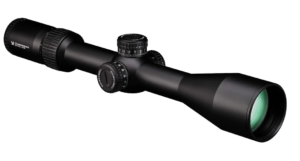
The Vortex Diamondback Tactical 6-24x50mm is an appealing entry-level option for shooters who want substantial magnification and useful long-range features without investing heavily in a premium optic. For a .300 Win Mag intended primarily for recreational precision shooting, it offers a straightforward feature set that covers many of the basics.
Its 6-24x magnification range provides plenty of reach for identifying and engaging distant targets, while the 50mm objective lens complements the higher magnification settings. The first focal plane EBR-2C reticle is particularly useful because its subtensions remain consistent throughout the magnification range. Shooters can use its references for holdovers and windage corrections without constantly worrying about whether the scope is set to the correct magnification.
The exposed tactical turrets provide convenient access to elevation and windage adjustments, while the side-focus parallax control accommodates different target distances. Vortex also includes fully multi-coated optics and a durable construction designed to handle normal field use. At approximately 24.6 ounces, it is noticeably lighter than several competing 5-25×56 precision scopes.
However, there are compromises. The Diamondback Tactical lacks the refinement of the more expensive Viper PST Gen II, particularly in its overall optical and adjustment experience. Its 6x minimum magnification also makes it less versatile for hunting in thick cover, and the non-illuminated reticle is less convenient in poor lighting.
I would place this scope firmly in the budget precision category rather than recommend it as a premium hunting optic. For shooters who prioritize magnification, a functional first focal plane reticle, and accessible pricing, it remains a worthwhile option.
Pros
- Affordable long-range scope.
- 6-24x magnification range.
- First focal plane EBR-2C reticle.
- Exposed tactical adjustment turrets.
- Side-focus parallax adjustment.
- Relatively manageable weight.
Cons
- No illuminated reticle.
- 6x minimum magnification limits hunting versatility.
- Optical performance is below premium Vortex models.
- No dedicated zero-stop system.
8) Primary Arms SLX 3-18x50mm FFP Gen II

The Primary Arms SLX 3-18x50mm FFP Gen II is one of the most disruptive values in the long-range optics market, and for 300 Win Mag shooters on a tighter budget, it’s genuinely exciting. The ACSS Athena BPR MIL reticle, exclusive to Primary Arms, is arguably the most user-friendly precision reticle on the market. It features automatic bullet drop compensation built directly into the reticle design, calibrated to match common 300 Win Mag loads, with wind dots and ranging capabilities that make field shooting intuitive rather than mathematical.
Being first focal plane, the reticle remains usable across all magnification levels, which matters when you’re quickly dialing between 3x for a close running shot and 18x for a precision stalk. The 50mm objective feeds the system enough light to keep the image bright and defined through dawn and dusk.
Build quality is solid, the turrets click cleanly, and the fit and finish are impressive at this price. If you’ve been priced out of premium glass, the SLX Gen II is the gateway to serious long-range shooting with your 300 Win Mag.
Pros
- Versatile 3-18x magnification range.
- First focal plane reticle.
- Multiple ACSS reticle configurations.
- Illuminated reticle with six settings.
- Side-focus parallax adjustment.
- Competitive feature set for its price.
Cons
- Relatively heavy at approximately 32 ounces.
- Optical refinement falls short of premium alternatives.
- Reticle complexity requires some familiarization.
How to Choose the Best Scope for Your 300 Win Mag
Picking the right scope for a 300 Win Mag isn’t just about matching magnification ranges on a spec sheet. Your intended use, hunting vs. precision target shooting, mountain backcountry vs. open prairie, should drive every decision. Here’s what to prioritize.
Magnification Range
The 300 Win Mag was designed to reach, but don’t over-magnify. A 4-16x or 5-25x range covers everything from hunting to precision target work. At 16x, you can confidently work 600-yard shots. Beyond 20x, mirage and shooter-induced error become larger factors than the scope’s capability.
Objective Lens Size
A 44mm to 50mm objective strikes the best balance for a 300 Win Mag build. Larger objectives gather more light, which matters for twilight hunting, but they also require higher rings, increasing cheek weld issues on many long-action rifles. The 44-50mm window offers plenty of brightness without forcing a compromised shooting position.
First vs. Second Focal Plane
For long-range shooting where you’ll use the reticle’s hash marks for holdovers and ranging, first focal plane (FFP) is the better choice, the reticle scales with magnification and stays accurate at any power. For traditional hunting where you simply center the crosshair and fire, second focal plane is simpler and often delivers a cleaner reticle view.
Turret Quality
The 300 Win Mag’s flat, predictable trajectory makes it very well-suited to dialing adjustments rather than holding over. Prioritize scopes with zero-stop, finger-adjustable, tactile-click turrets if you plan to reach past 500 yards. Scopes without reliable zero-stops are frustrating in field conditions where you need to return to your hunting zero quickly.
Glass Quality and Coatings
Light transmission, contrast, and edge-to-edge sharpness separate adequate glass from exceptional glass. Look for fully multi-coated lenses at minimum, better scopes feature XD, HD, or Index Matched Lens elements. For low-light hunting, a scope with quality twilight-enhancing coatings (like Leupold’s Twilight Max) genuinely extends your effective shooting window.
Budget Alignment
The 300 Win Mag is a cartridge that rewards precision, and your optic investment should reflect that. Spend at least as much on your scope as you spent on your rifle. Putting a $200 scope on a $1,200 rifle is a lopsided investment. The scopes in this guide range from excellent budget choices like the Primary Arms SLX to professional-grade glass like the Nightforce ATACR — there’s a strong option for every realistic budget.
FAQs
What is the effective range of a .300 Win Mag?
The .300 Win Mag is effective for hunting out to about 500–800 yards in the hands of a skilled shooter. For target shooting, it is commonly used at 1,000 yards and beyond due to its flat trajectory and excellent energy retention.
Is a .300 Win Mag more powerful than a .308?
Yes. It’s not even a close contest. The .300 Win Mag is substantially more powerful than the .308 Winchester in every measurable category, velocity, energy, and effective range. Both cartridges fire .30-caliber bullets, but the .300 Win Mag’s larger case capacity allows it to push those bullets 300 to 400 fps faster, which translates to a noticeably flatter trajectory and significantly more retained energy at distance.
Is the .300 Win Mag better than the .30-06?
Both cartridges are excellent, but the answer depends on what you’re asking of them. The .300 Win Mag is the more powerful round, it pushes the same .30-caliber bullets significantly faster, producing a flatter trajectory, more retained energy at distance, and a meaningful edge beyond 400 yards. For elk at 600 yards or long-range precision work, it’s the clear winner.
The .30-06, however, is no slouch. It handles every North American big game animal effectively out to practical hunting ranges, produces less recoil, is cheaper to feed, and is available in lighter, more packable rifles. If you’re shooting past 400 yards regularly or hunting in wide-open country where distance is a factor, the .300 Win Mag earns its place. If you’re a meat hunter working inside 350 yards in timber or mixed terrain, the .30-06 does the job with less punishment on your shoulder and your wallet. The .300 Win Mag is the better long-range cartridge; the .30-06 is the better all-around utility round.
What scope magnification is best for a .300 Win Mag?
For most hunting situations, a 3-15x, 4-16x, or 4-20x scope is ideal. Shooters focused on long-range target shooting often choose scopes in the 5-25x range.
Final Thoughts
The 300 Winchester Magnum deserves an optic that respects its range and capability. Every scope in this guide brings something genuine to the table.
Match the scope to the mission. Identify how far you’re realistically shooting, what conditions you’ll face, and what your rifle build is worth, then invest accordingly. The right glass turns a great cartridge into a system that can reliably perform at ranges most hunters and shooters never imagined possible.
Related